
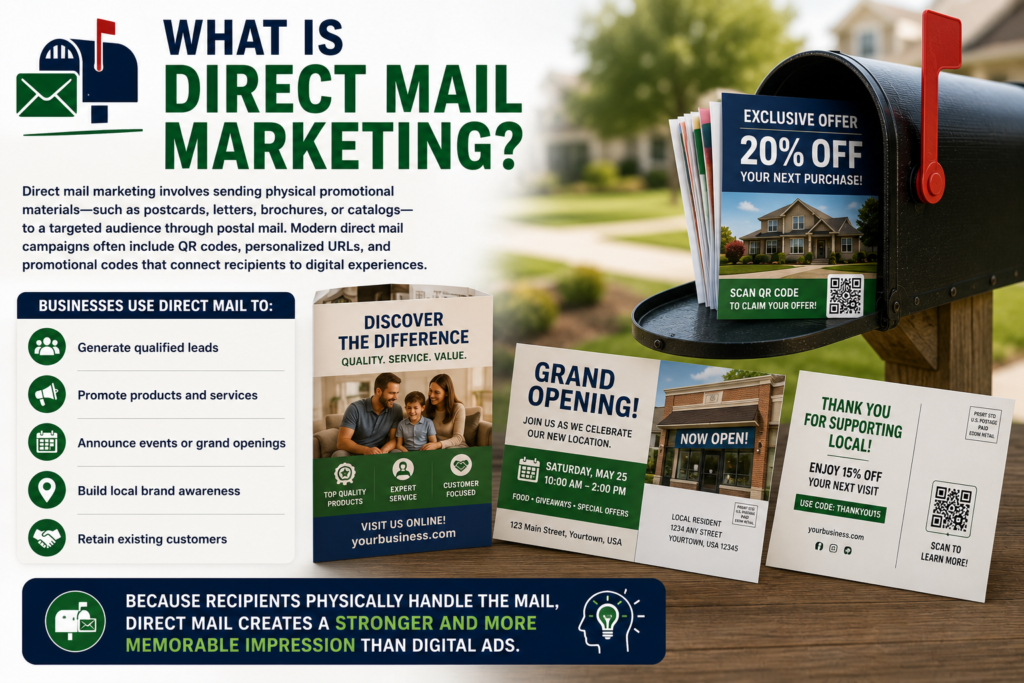
Marketing continues to evolve, but one question remains common among businesses of all sizes: Should you invest in direct mail or email marketing? While email has become a staple of digital communication, direct mail marketing has experienced a resurgence thanks to improved targeting, personalization, and integration with online channels.
Rather than choosing one over the other, it’s important to understand the strengths and limitations of each. In this guide, we’ll compare direct mail vs email marketing, examine their performance in 2026, and help you decide which approach is best for your business goals.
What Is Email Marketing?
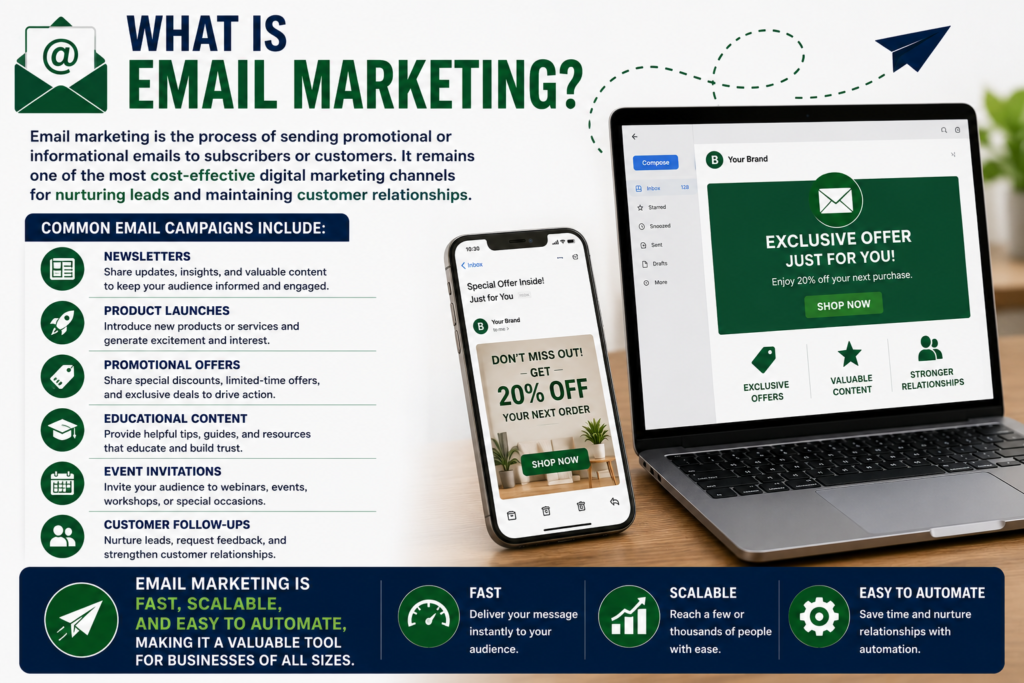
Email marketing is the process of sending promotional or informational emails to subscribers or customers. It remains one of the most cost-effective digital marketing channels for nurturing leads and maintaining customer relationships.
Common email campaigns include:
- Newsletters
- Product launches
- Promotional offers
- Educational content
- Event invitations
- Customer follow-ups
Email marketing is fast, scalable, and easy to automate, making it a valuable tool for businesses of all sizes.
Direct Mail vs Email Marketing: Key Differences
| Feature | Direct Mail Marketing | Email Marketing |
| Delivery | Physical mailbox | Email inbox |
| Cost | Higher per campaign | Lower per campaign |
| Personalization | High | High |
| Speed | Several days | Instant |
| Engagement | High attention span | Depends on open rates |
| Lifespan | Days or weeks | Often minutes or hours |
| Tracking | QR codes, promo codes, call tracking | Opens, clicks, conversions |
| Best For | Brand awareness, local outreach, premium offers | Lead nurturing, updates, repeat engagement |
Both channels have unique strengths, and the right choice depends on your objectives.
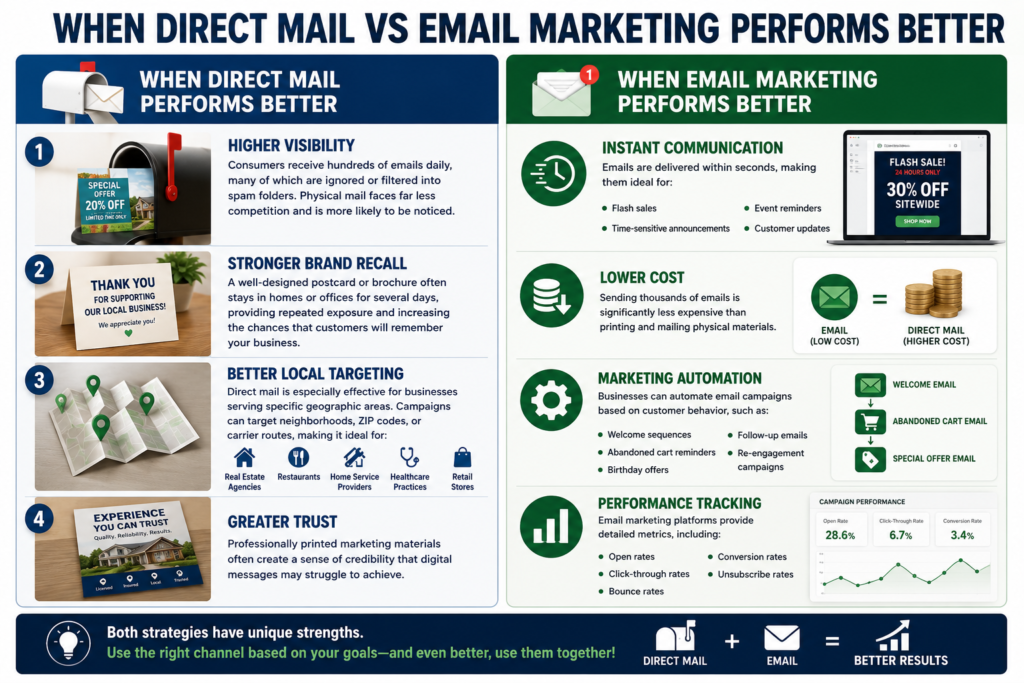
When Direct Mail Performs Better
1. Higher Visibility
Consumers receive hundreds of emails daily, many of which are ignored or filtered into spam folders. Physical mail faces far less competition and is more likely to be noticed.
2. Stronger Brand Recall
A well-designed postcard or brochure often stays in homes or offices for several days, providing repeated exposure and increasing the chances that customers will remember your business.
3. Better Local Targeting
Direct mail is especially effective for businesses serving specific geographic areas. Campaigns can target neighborhoods, ZIP codes, or carrier routes, making it ideal for:
- Real estate agencies
- Restaurants
- Home service providers
- Healthcare practices
- Retail stores
4. Greater Trust
Professionally printed marketing materials often create a sense of credibility that digital messages may struggle to achieve.
When Email Marketing Performs Better
Instant Communication
Emails are delivered within seconds, making them ideal for:
- Flash sales
- Time-sensitive announcements
- Event reminders
- Customer updates
Lower Cost
Sending thousands of emails is significantly less expensive than printing and mailing physical materials.
Marketing Automation
Businesses can automate email campaigns based on customer behavior, such as:
- Welcome sequences
- Abandoned cart reminders
- Birthday offers
- Follow-up emails
- Re-engagement campaigns
Automation helps businesses maintain consistent communication with minimal manual effort.
Performance Tracking
Email marketing platforms provide detailed metrics, including:
- Open rates
- Click-through rates
- Bounce rates
- Conversion rates
- Unsubscribe rates
These insights make it easier to optimize future campaigns.
Comparing ROI
Both direct mail and email marketing can produce excellent returns when used strategically.
Direct Mail ROI
Direct mail often generates strong response rates because it captures attention in a less crowded environment. Personalized campaigns with compelling offers can produce high-quality leads and long-term customer relationships.
Email Marketing ROI
Email marketing excels in nurturing existing customers and encouraging repeat purchases. Because the cost of sending emails is relatively low, even modest conversion rates can deliver a high return on investment.
Rather than asking which channel has the higher ROI, businesses should consider which one aligns with their audience and campaign objectives.
Why Combining Direct Mail and Email Works Best
The most successful businesses don’t rely on a single marketing channel. Instead, they integrate direct mail and email into a cohesive multichannel strategy.
For example:
- Send a direct mail postcard introducing a new product or service.
- Include a QR code that directs recipients to a landing page.
- Capture email addresses through a special offer or downloadable resource.
- Follow up with a personalized email sequence.
- Use email to nurture leads and encourage repeat purchases.
This approach creates multiple touchpoints, increases brand familiarity, and improves conversion rates.
Which Businesses Should Use Direct Mail?
Direct mail is especially effective for:
- Home improvement companies
- HVAC and plumbing services
- Roofing contractors
- Dental and medical practices
- Real estate agencies
- Financial advisors
- Retail stores
- Restaurants
- Local service providers
These businesses often benefit from reaching customers within specific geographic areas.
Which Businesses Should Focus on Email Marketing?
Email marketing is ideal for businesses that:
- Operate online
- Sell subscription services
- Run eCommerce stores
- Publish regular content
- Offer membership programs
- Need ongoing customer communication
Email is particularly valuable for retaining existing customers and building long-term relationships.
Common Mistakes to Avoid
Whether you choose direct mail, email, or both, avoid these common mistakes:
- Sending generic messages to broad audiences
- Ignoring customer segmentation
- Using weak calls-to-action
- Failing to personalize content
- Not tracking campaign performance
- Overlooking mobile-friendly landing pages
- Treating direct mail and email as separate strategies instead of complementary channels
A coordinated approach delivers better results than isolated campaigns.
Frequently Asked Questions
Is direct mail more effective than email marketing?
Not necessarily. Direct mail often excels at capturing attention and generating local awareness, while email is better suited for ongoing communication and lead nurturing. The best choice depends on your business goals.
Is email marketing still effective in 2026?
Yes. Email remains one of the most cost-effective marketing channels, particularly for customer retention, promotions, and automated communication.
Can I use direct mail and email together?
Absolutely. Combining the two creates a multichannel strategy that increases engagement, reinforces messaging, and improves overall campaign performance.
Which strategy is better for small businesses?
Many small businesses benefit from using both. Direct mail can attract new local customers, while email helps maintain relationships and encourage repeat business.
Final Thoughts
When comparing direct mail vs email marketing, there is no universal winner. Direct mail marketing excels at creating memorable, tangible experiences that capture attention and build trust, while email marketing offers speed, automation, and cost-effective customer engagement. In 2026, the most successful businesses combine both strategies to reach customers across multiple touchpoints. By integrating direct mail with email campaigns, businesses can generate more leads, improve customer retention, and maximize their overall marketing ROI.