
Generating qualified B2B leads can be challenging. Business decision-makers receive countless emails, advertisements, sales messages, and LinkedIn notifications every day. In such a crowded environment, it can be difficult for a company to capture attention and stand out from competitors.
B2B direct mail provides a different way to reach prospects by putting a physical marketing message directly in front of the people who matter. When combined with accurate targeting, personalized messaging, compelling offers, and digital follow-up, direct mail can become an effective part of a modern B2B lead generation strategy.
If you’re planning a B2B direct mail campaign and want help with targeting, design, printing, and mailing, Get a Free Quote to discuss your campaign requirements and goals.
In this guide, we’ll explore seven B2B direct mail marketing strategies that can help businesses reach decision-makers, generate high-quality leads, and create stronger connections with potential customers.
What Is B2B Direct Mail?
B2B direct mail is a marketing strategy that uses physical mail to reach businesses, business owners, executives, managers, purchasing teams, and other professional decision-makers.
Instead of communicating exclusively through digital channels, companies can use physical marketing materials such as:
- Postcards
- Letters
- Brochures
- Catalogs
- Dimensional mailers
- Personalized promotional materials
- Sales packages
The objective is to deliver a relevant message to a specific business audience and encourage them to take an action, such as requesting a consultation, visiting a website, scheduling a demonstration, or contacting a sales representative.
How B2B Direct Mail Differs From Consumer Direct Mail
Consumer campaigns typically target individuals or households.
B2B campaigns often require more detailed targeting because purchasing decisions may involve multiple people within an organization.
Businesses may target prospects based on:
- Industry
- Company size
- Job title
- Geographic location
- Revenue
- Business type
- Previous interactions
- Purchasing behavior
- Technology used
- Account status
This makes audience selection particularly important for B2B direct mail.
Why B2B Direct Mail Still Works
Digital marketing is essential for most B2B businesses, but digital channels are increasingly competitive.
Email inboxes are crowded, online advertisements compete for attention, and social media feeds move quickly.
Physical mail provides a different experience.
A well-designed mailpiece can:
- Stand out from digital messages
- Create physical brand exposure
- Communicate a focused offer
- Support account-based marketing
- Reinforce brand credibility
- Encourage a specific response
B2B direct mail can be particularly useful when the campaign is carefully targeted rather than sent to a broad, unrelated audience.
1. Build a Highly Targeted Mailing List
The quality of your mailing list can have a major impact on campaign performance.
Sending an excellent mailpiece to the wrong audience will not generate the results you want.
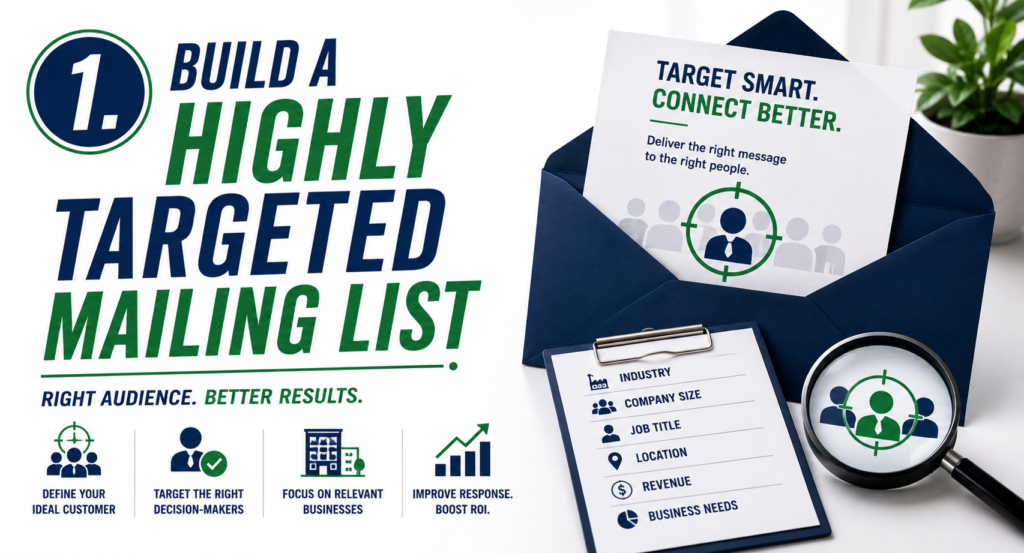
Before launching a campaign, identify the types of companies and decision-makers most likely to need your product or service.
Define Your Ideal B2B Customer
Start by creating an ideal customer profile.
Consider:
- Industry
- Company size
- Location
- Number of employees
- Revenue range
- Job roles
- Business needs
- Purchasing authority
- Current challenges
For example, a commercial software company might target operations managers at mid-sized businesses rather than mailing every business in a particular area.
This level of targeting can help reduce wasted mailing costs and improve campaign relevance.
Target Decision-Makers
Whenever possible, identify the individuals who influence or make purchasing decisions.
Depending on your industry, this could include:
- CEOs
- Business owners
- Marketing directors
- Operations managers
- Procurement managers
- Sales directors
- IT managers
- Office managers
- Purchasing directors
Reaching the appropriate person increases the chances that your message will reach someone who can take action.
2. Personalize Your B2B Direct Mail Marketing
Personalization can make a B2B campaign more relevant.
Instead of sending the same message to every prospect, customize your communication based on the recipient’s business, industry, role, or potential needs.
Personalization can include:
- Recipient name
- Company name
- Industry
- Location
- Job title
- Relevant business challenge
- Product or service recommendation
- Personalized offer
For example, a marketing agency could send a campaign to local business owners with messaging focused on improving lead generation.
A technology company could create separate mailers for healthcare organizations, financial companies, and professional service businesses.
Go Beyond Adding a Name
Simply inserting someone’s name into a mailpiece is not enough to make a campaign truly personalized.
Effective personalization connects the message to a relevant business problem.
For example:
“Help Your Chicago Dental Practice Generate More Qualified Patient Leads”
is more specific than:
“Grow Your Business With Our Services.”
The first message speaks directly to an audience and a potential need.

3. Create a Compelling Offer
Your mailpiece needs to give prospects a reason to respond.
B2B purchasing decisions can take time, so your offer should provide a clear and valuable next step.
Effective B2B offers can include:
- Free consultation
- Free business assessment
- Product demonstration
- Free audit
- Strategy session
- Sample or trial
- Industry report
- Free estimate
- Limited-time discount
- Complimentary analysis
The best offer depends on your industry and sales process.
Make the Value Clear
Your recipient should quickly understand what they receive by responding.
Instead of focusing entirely on your company, explain the benefit.
For example:
“Get a Free Website Performance Audit”
is more action-oriented than:
“Learn About Our Digital Marketing Services.”
A clear offer can make it easier for prospects to understand why they should respond.
4. Use Strong B2B Direct Mail Design
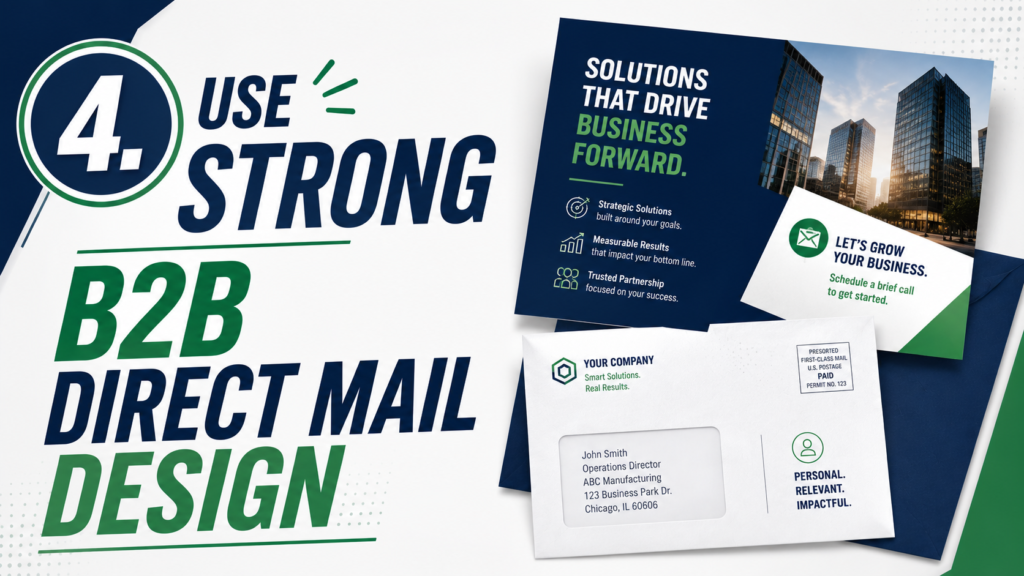
The physical appearance of your mailpiece can influence whether a prospect pays attention to it.
Professional design should make your message easy to understand within seconds.
Focus on One Main Message
Avoid trying to explain everything about your company on one postcard or brochure.
Focus on:
- One primary audience
- One main problem
- One compelling benefit
- One offer
- One call-to-action
A simple message can be easier for busy business professionals to process.
Include Essential Information
Your mailpiece should clearly communicate:
- Company name
- Main benefit
- Offer
- Contact information
- Website
- Call-to-action
- QR code, if applicable
Use professional images and consistent branding to create a credible presentation.
5. Combine Targeted Direct Mail With Digital Marketing
B2B direct mail doesn’t have to operate independently.
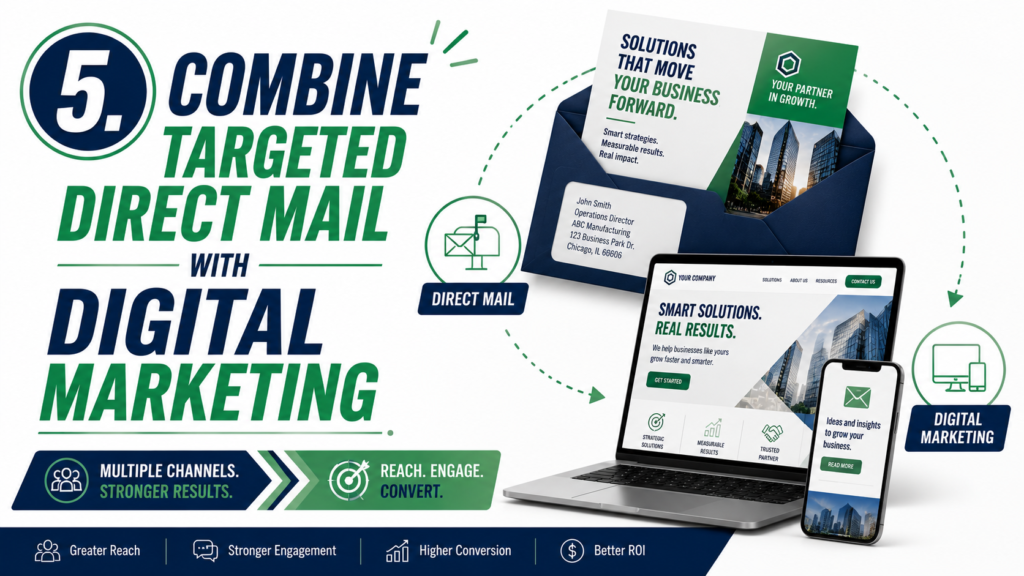
Combining physical mail with digital channels can create multiple opportunities to reach prospects.
A campaign might work like this:
Targeted mailpiece → QR code → Landing page → Lead form → Email follow-up → Sales outreach
The physical mailpiece introduces the offer, while digital channels make it easier for the prospect to research the company and take action.
Use QR Codes Strategically
A QR code can connect your physical mailpiece to:
- Landing pages
- Product demonstrations
- Consultation forms
- Case studies
- Appointment scheduling
- Special offers
- Product pages
Make sure the QR code leads directly to content related to the mailpiece.
6. Use Account-Based Marketing for High-Value Prospects
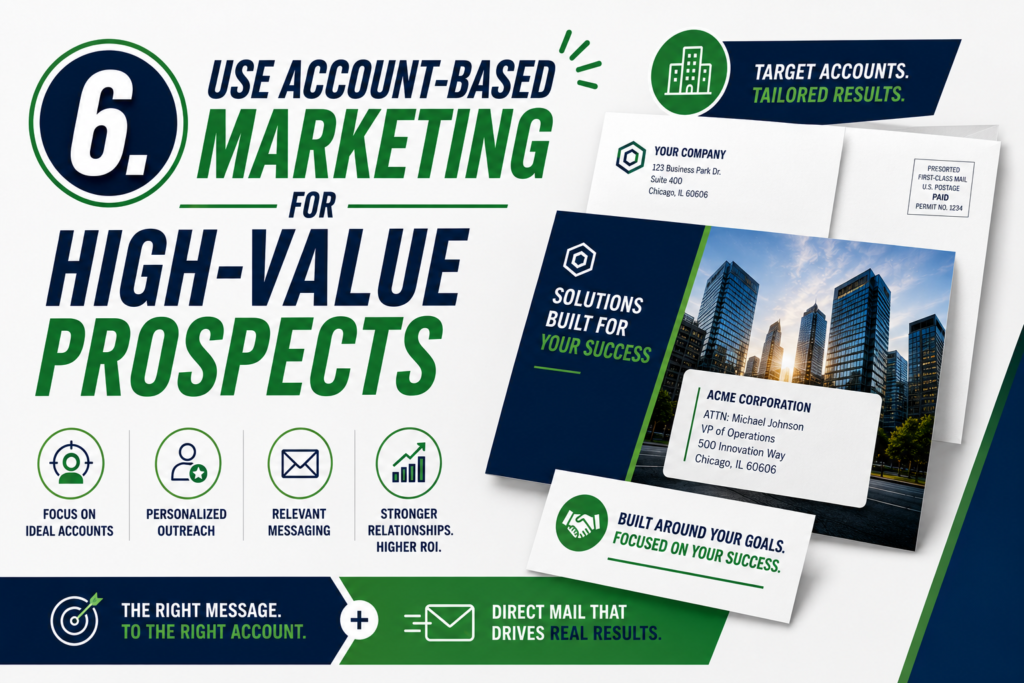
B2B companies selling high-value products or services may benefit from combining direct mail with account-based marketing.
Instead of targeting a large general audience, businesses can identify specific companies they want to work with.
A campaign could target 50, 100, or several hundred high-value accounts with customized messaging.
Create Account-Specific Campaigns
For important prospects, consider creating mailpieces based on:
- Company challenges
- Industry
- Recent business developments
- Job role
- Existing relationship
- Potential product needs
For example, a software company could send a personalized package to the operations director of a target organization and follow it with an email from the sales team.
This creates a coordinated experience across sales and marketing.
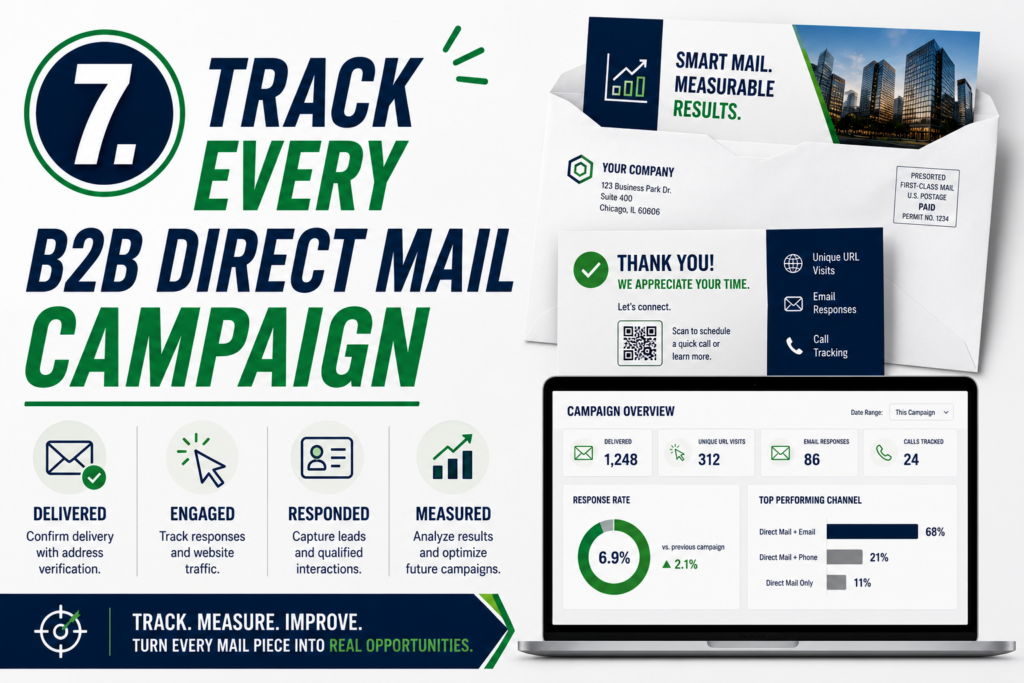
7. Track Every B2B Direct Mail Campaign
Tracking is essential if you want to understand whether your campaign is producing results.
Without tracking, it can be difficult to determine which mailpieces, offers, or audiences generate leads.
Track Important Metrics
Depending on your campaign, monitor:
- Response rate
- QR code scans
- Website visits
- Landing page visits
- Form submissions
- Phone calls
- Consultation requests
- Demo requests
- Qualified leads
- Sales opportunities
- Closed deals
- Revenue
- Cost per lead
These metrics can help you evaluate the effectiveness of your campaign.
Use Campaign-Specific Tracking
Consider using:
- Unique landing pages
- QR codes
- Promotional codes
- Dedicated phone numbers
- UTM parameters
- CRM campaign tracking
For example, instead of sending every recipient to your homepage, create a campaign-specific landing page that allows you to measure traffic and conversions more accurately.
How to Create a Successful B2B Direct Mail Campaign
A successful campaign requires more than simply printing and mailing promotional materials.
Step 1: Establish Your Goal
Determine what you want the campaign to accomplish.
Your objective could be:
- Generate qualified leads
- Book sales meetings
- Increase product demonstrations
- Promote a new service
- Reach new accounts
- Re-engage previous customers
- Increase sales
A specific goal makes it easier to measure performance.
Step 2: Identify Your Audience
Build a mailing list based on your ideal customer profile.
Consider industry, company size, location, job title, and purchasing needs.
Step 3: Select the Right Mail Format
Choose a format that matches your campaign.
Postcards can work well for simple promotional messages.
Letters can provide a more personalized experience.
Brochures are useful when you need more space to explain a product or service.
Dimensional mailers can help high-value campaigns stand out.
Step 4: Develop Your Message
Focus on the prospect rather than simply describing your company.
Identify a problem and explain how your product or service can help solve it.
Step 5: Create a Strong Offer
Give the prospect a compelling reason to respond.
Make the offer relevant to the audience and easy to understand.
Step 6: Add a Digital Call-to-Action
Use a QR code or unique URL to connect the mailpiece with a landing page.
Make the online experience consistent with the physical campaign.
Step 7: Plan Your Follow-Up
Determine what happens after the mail is delivered.
Follow-up can include:
- Phone calls
- LinkedIn outreach
- Digital advertising
- Sales presentations
- Additional mail
Step 8: Measure Results
Review campaign data and compare the results with your original goals.
Use those insights to improve your next campaign.
B2B Direct Mail Marketing Best Practices
Following a few best practices can improve the effectiveness of your campaigns.
Keep Your Message Relevant
A B2B audience is more likely to respond to a message that addresses a genuine business need.
Focus on Benefits
Explain how your product or service can help the prospect save time, reduce costs, increase revenue, improve efficiency, or solve a specific challenge.
Use Professional Design
Your mailpiece represents your business. Use clear layouts, high-quality printing, and consistent branding.
Include One Strong Call-to-Action
Don’t give recipients too many options.
Choose the action that matters most to your campaign.
Follow Up Quickly
If a prospect responds, timely follow-up can help maintain their interest.
Test Different Approaches
Test different:
- Headlines
- Offers
- Designs
- Mail formats
- Audiences
- Calls-to-action
Use performance data to determine what works best.
Common B2B Direct Mail Mistakes to Avoid
Even well-funded campaigns can underperform if basic mistakes are made.
Targeting the Wrong Audience
An inaccurate mailing list can result in wasted money and low response rates.
Using Generic Messaging
Generic messaging can make your campaign feel irrelevant.
Providing a Weak Offer
A prospect needs a clear reason to respond.
Adding Too Much Information
Too much text can make a mailpiece difficult to read.
Forgetting Digital Integration
A QR code, landing page, or online form can make it easier for prospects to respond.
Failing to Track Results
If you don’t measure performance, you won’t know what needs improvement.
Ignoring Follow-Up
Direct mail should often be part of a broader sales and marketing process rather than a one-time communication.
Industries That Can Benefit From B2B Direct Mail
B2B direct mail can work across many industries.
Technology Companies
Technology businesses can use direct mail to promote software, IT services, cybersecurity solutions, and demonstrations.
Professional Services
Consulting firms, marketing agencies, accounting firms, and other professional service providers can use direct mail to reach business decision-makers.
Manufacturing
Manufacturers can target purchasing managers and operations teams with product information, catalogs, samples, or sales offers.
Commercial Real Estate
Commercial real estate professionals can use direct mail to reach property owners, investors, and business decision-makers.
Business-to-Business Services
Cleaning companies, office suppliers, logistics providers, printing companies, and other service businesses can use targeted campaigns to reach potential commercial clients.
Benefits of B2B Direct Mail
When properly planned and targeted, B2B direct mail can provide several advantages.
Reaches Decision-Makers
Targeted campaigns can be designed around specific job titles and organizations.
Creates Physical Brand Exposure
A physical mailpiece can provide a different experience from an email or digital advertisement.
Supports Account-Based Marketing
Businesses can create highly customized campaigns for valuable target accounts.
Works With Digital Marketing
QR codes, landing pages, email, and digital advertising can extend the campaign beyond the mailbox.
Provides Measurable Results
Campaign-specific tracking can help businesses evaluate responses, leads, opportunities, and revenue.
Supports Long-Term Lead Generation
A well-planned campaign can be incorporated into an ongoing sales and marketing strategy.
Frequently Asked Questions
What is B2B direct mail?
B2B direct mail is a marketing strategy that uses physical mail to reach businesses, executives, owners, managers, and other professional decision-makers.
Is B2B direct mail effective for lead generation?
B2B direct mail can support lead generation when campaigns are properly targeted, personalized, designed around a relevant offer, and followed by appropriate sales or digital marketing activities.
What is the best type of B2B direct mail?
The best format depends on your audience and campaign goal. Postcards, letters, brochures, catalogs, and personalized mailers can all be effective for different B2B campaigns.
How can targeted direct mail improve B2B campaigns?
Targeted direct mail focuses marketing efforts on companies and decision-makers who are more likely to need the product or service. This can reduce wasted mailing and improve campaign relevance.
Should B2B direct mail be combined with digital marketing?
Yes. Combining direct mail with email, landing pages, QR codes, social media, search marketing, and digital advertising can create additional touchpoints and make it easier to track customer actions.
How do I measure a B2B direct mail campaign?
Businesses can track QR scans, landing page visits, form submissions, phone calls, meetings, qualified leads, sales opportunities, revenue, and cost per acquisition.
Final Thoughts
B2B direct mail can be a valuable part of a modern lead generation strategy when it is built around the right audience, message, offer, and follow-up process.
The most successful campaigns don’t simply send promotional materials to a large list of businesses. They identify the right prospects, personalize the message, provide a compelling reason to respond, and connect physical mail with digital marketing and sales activities.
From targeted mailing lists and personalized messaging to QR codes, account-based marketing, and campaign tracking, businesses have numerous opportunities to make their direct mail campaigns more relevant and measurable.
Whether you’re trying to reach a handful of high-value accounts or build a larger B2B prospecting campaign, a strategic approach can help turn direct mail into a stronger lead generation channel.
If you’re ready to plan your next B2B direct mail campaign, Get a Free Quote to explore mailing options, audience targeting, campaign design, and execution for your business.