
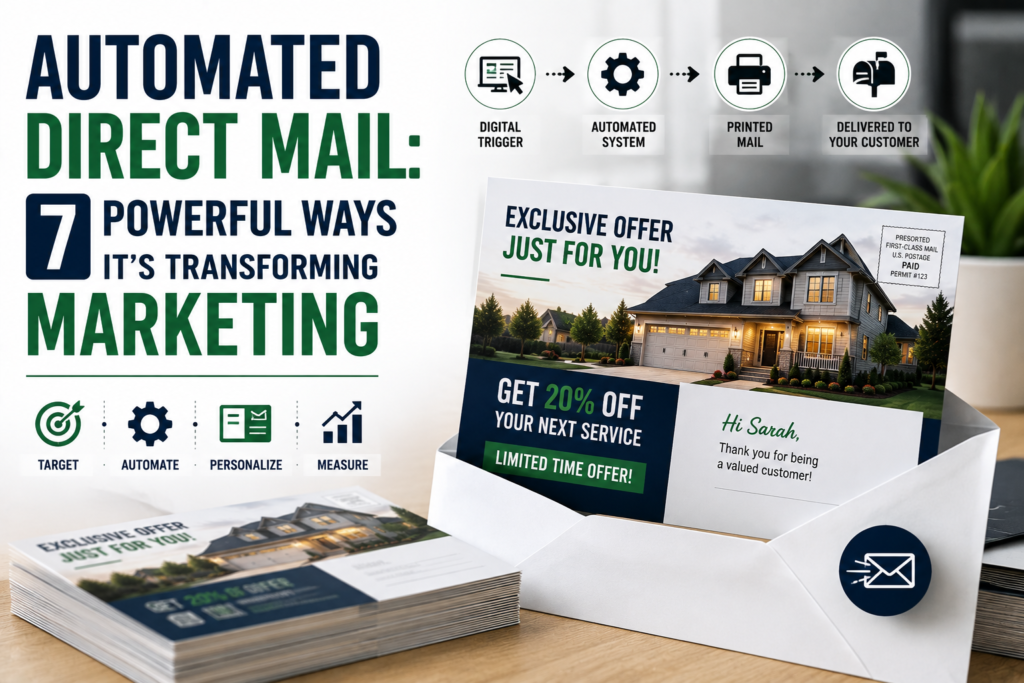
Marketing is becoming increasingly automated. Businesses use technology to personalize emails, manage social media campaigns, automate customer follow-ups, and deliver targeted digital advertisements. Now, automation is transforming the way businesses plan, personalize, and execute direct mail campaigns as well.
Automated direct mail combines traditional physical mail with modern marketing technology. Instead of manually managing every mailing, businesses can use automation to trigger postcards, letters, and other mailpieces based on customer actions, audience data, campaign schedules, or marketing events.
Thinking about using automated direct mail for your business? Get a Free Quote to discuss your campaign goals, audience, automation requirements, and direct mail strategy.
In this guide, we’ll explore seven powerful ways automated direct mail is transforming marketing campaigns and explain how businesses can use technology to make their direct mail more targeted, efficient, personalized, and measurable.
What Is Automated Direct Mail?
Automated direct mail is a marketing approach that uses technology and software to automate parts of the direct mail process.
Traditional direct mail campaigns often require businesses to manually prepare mailing lists, organize mailpieces, coordinate schedules, and manage follow-ups.
With automation, businesses can create rules or triggers that determine when a customer should receive a physical marketing piece.
For example:
A customer visits a website → Customer completes a form → Marketing system triggers a postcard → Postcard is printed and mailed → Customer visits a landing page → Sales team follows up.
This creates a connection between digital customer activity and physical marketing.
Automated direct mail can be used for:
- Lead generation
- Customer acquisition
- Retargeting
- Abandoned cart campaigns
- Customer retention
- Appointment reminders
- Promotional campaigns
- New customer onboarding
- Event marketing
- Re-engagement campaigns
1. Automation Makes Direct Mail Faster and More Efficient
One of the biggest advantages of automated direct mail is efficiency.
Traditional campaigns may require multiple manual steps, including:
- Preparing mailing lists
- Formatting addresses
- Creating mailpieces
- Sending files to printers
- Coordinating fulfillment
- Scheduling mailings
- Tracking campaign activity
Automation can reduce the amount of manual work involved.
A business can establish campaign rules in advance and allow technology to handle specific tasks when predetermined conditions are met.
For example, a company could create an automated campaign that sends a postcard to a new customer several days after their first purchase.
Instead of manually checking customer records and preparing individual mailings, the process can be triggered automatically.
This allows marketing teams to spend more time on strategy and customer relationships.
2. Automated Direct Mail Enables Personalization
Personalization has become an important part of modern marketing.
Customers are more likely to respond to messages that feel relevant to their needs, interests, location, or previous interactions.
An automated direct mail system can use customer data to personalize physical marketing materials.
Depending on the available data, businesses may personalize:
- Customer names
- Addresses
- Offers
- Product recommendations
- Images
- Service information
- Locations
- Promotional codes
- Landing page URLs
For example, instead of sending the same postcard to every customer, an automated system could send different offers based on previous purchases.
A customer who purchased a particular service could receive a postcard promoting a related service.
This makes the physical mailpiece more relevant while reducing the need for manual campaign management.
Why Personalization Matters
Personalized direct mail can help businesses create a more individual customer experience.
Rather than receiving a generic advertisement, the customer receives a message that is connected to their relationship with the brand.
This can support:
- Higher engagement
- Better customer experiences
- Increased response rates
- Stronger brand relationships
- More relevant offers
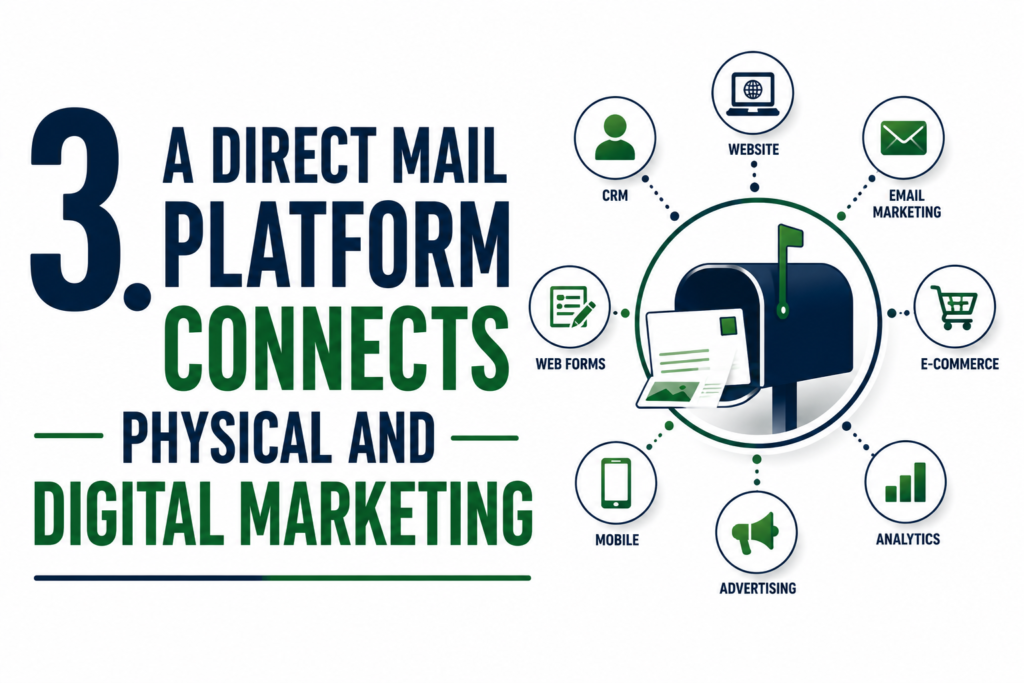
3. A Direct Mail Platform Connects Physical and Digital Marketing
A modern direct mail platform can connect direct mail with other marketing technologies.
Instead of treating direct mail as a separate channel, businesses can integrate it into their broader marketing ecosystem.
Depending on the platform and integrations available, direct mail can work alongside:
- CRM systems
- Email marketing
- Marketing automation
- Customer databases
- E-commerce platforms
- Analytics tools
- Advertising platforms
- Website forms
For example, a customer may interact with a company’s website and trigger a direct mail campaign based on that activity.
This creates a connected customer journey across multiple channels.
Example of an Integrated Campaign
Consider an online retailer:
- A customer visits the website.
- The customer adds a product to their cart.
- The customer leaves without purchasing.
- The business sends an automated email.
- If the customer still doesn’t purchase, an automated postcard is triggered.
- The postcard includes a personalized offer.
- The customer scans a QR code and returns to the website.
- The customer completes the purchase.
In this example, physical mail becomes part of a larger automated marketing journey.
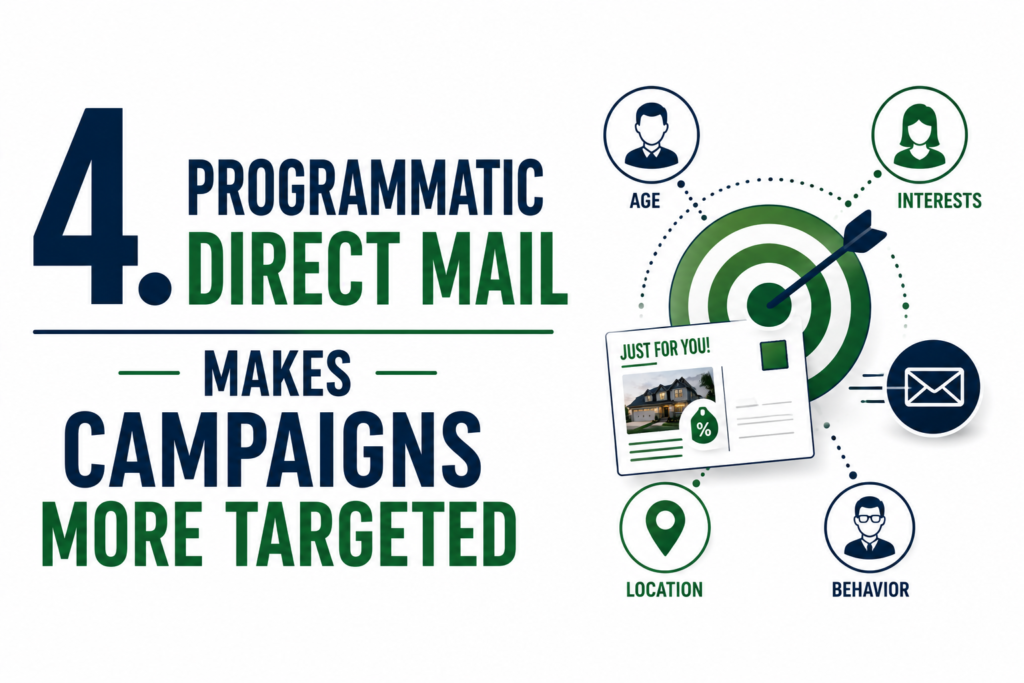
4. Programmatic Direct Mail Makes Campaigns More Targeted
Programmatic direct mail applies data-driven automation principles to physical marketing.
The concept is similar to programmatic digital advertising, where technology uses customer information and predefined rules to deliver relevant advertising.
With programmatic direct mail, businesses can use data and automated triggers to determine:
- Who receives a mailpiece
- When it is sent
- What message it contains
- Which offer is presented
- Which creative is used
- Where the recipient is directed online
This can make direct mail more responsive to customer behavior.
For example, an insurance company could send different mailpieces based on a customer’s stage in the buying journey.
A new prospect might receive an introductory offer, while an existing customer could receive a renewal reminder or cross-sell promotion.
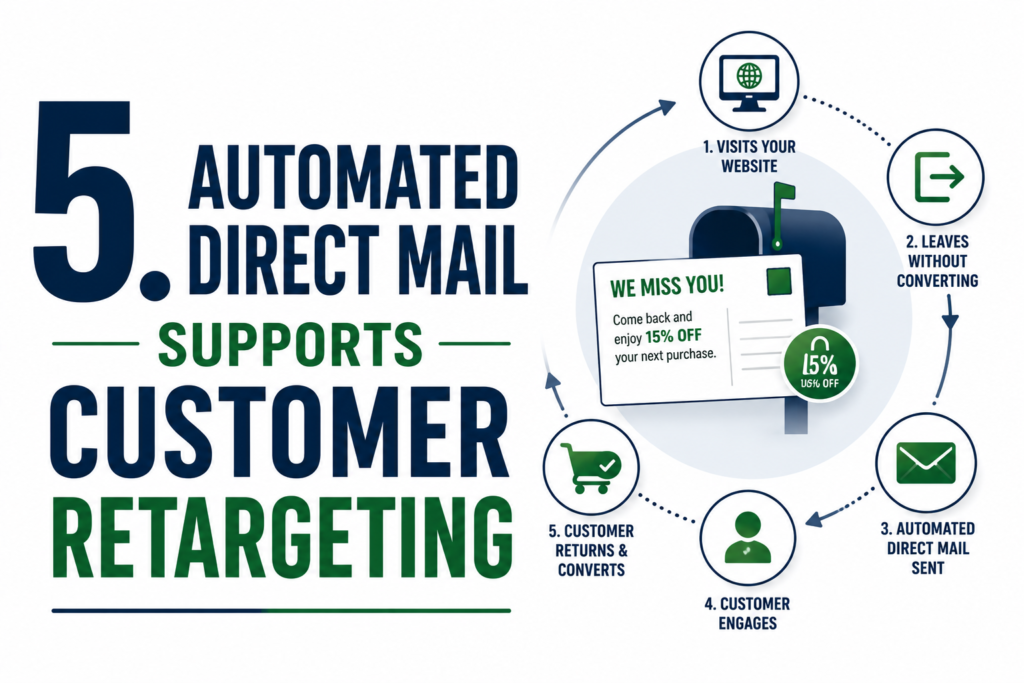
5. Automated Direct Mail Supports Customer Retargeting
Retargeting is commonly associated with digital advertising, but businesses can also use physical mail to reconnect with potential customers.
For example, a customer may:
- Visit a website
- Browse a product
- Request information
- Start an application
- Add an item to a shopping cart
- Download a guide
- Begin scheduling an appointment
If the customer doesn’t complete the desired action, an automated direct mail campaign can potentially be triggered based on the available data and integrations.
A physical postcard or letter can provide another opportunity to bring the customer back to the business.
This is particularly useful because physical mail can complement digital retargeting rather than simply repeating the same online advertisement.
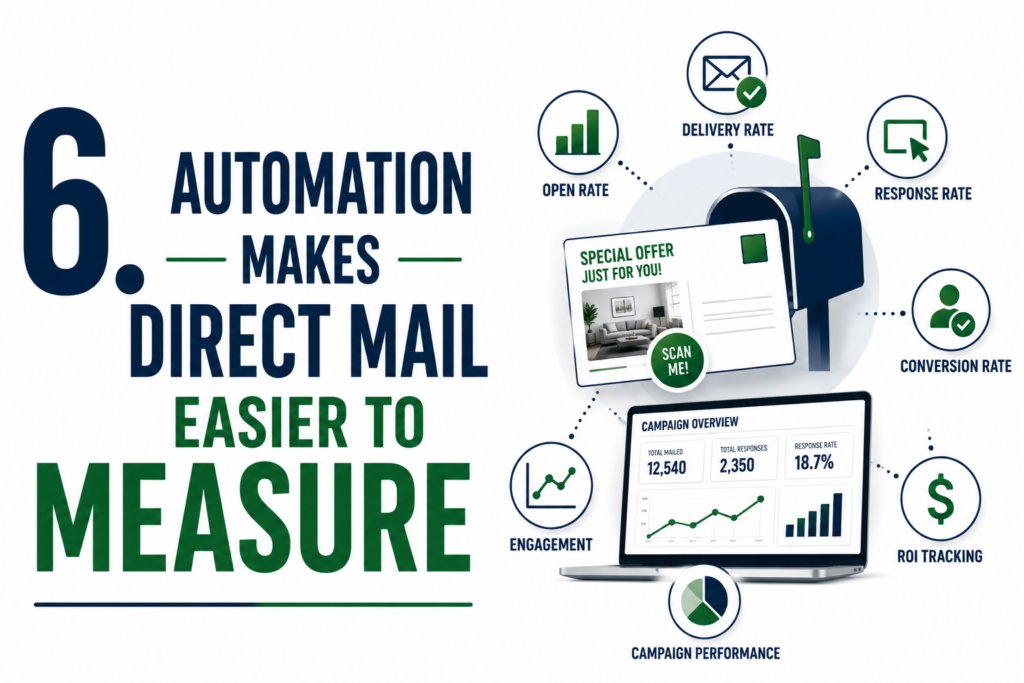
6. Automation Makes Direct Mail Easier to Measure
One of the challenges of traditional direct mail is determining exactly how recipients respond.
Modern technology can make campaign tracking easier.
Businesses can use:
- QR codes
- Unique URLs
- Promotional codes
- Personalized landing pages
- Dedicated phone numbers
- Online forms
- CRM tracking
For example, an automated direct mail campaign can send customers to a unique landing page.
The business can then track:
- Visits
- Form submissions
- Purchases
- Appointment requests
- Downloads
- Calls
This data helps businesses understand which campaigns are generating results.
Important Metrics to Track
Depending on your campaign objectives, monitor:
- Response rate
- Website traffic
- QR code scans
- Leads generated
- Conversion rate
- Sales
- Cost per lead
- Customer acquisition cost
- Revenue
- Return on investment
The more accurately a campaign is tracked, the easier it becomes to improve future marketing efforts.
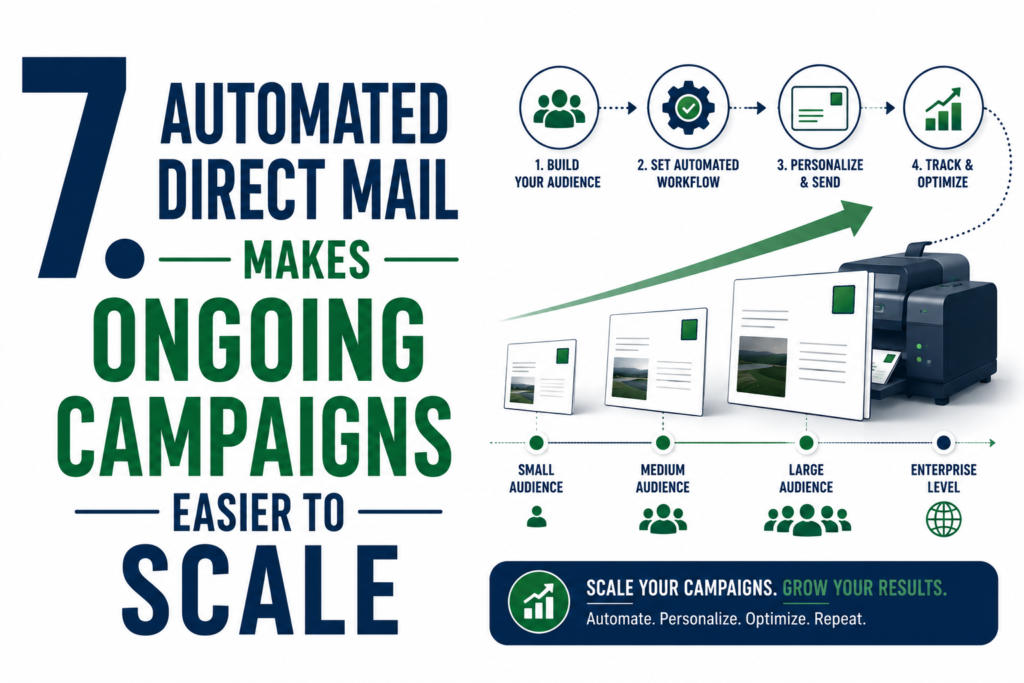
7. Automated Direct Mail Makes Ongoing Campaigns Easier to Scale
Running one direct mail campaign is different from managing a continuous marketing program.
Automation becomes particularly valuable when businesses want to send physical mail regularly.
Instead of manually creating every campaign, businesses can establish automated workflows.
Examples include:
New Customer Campaign
A customer makes their first purchase and automatically receives a thank-you postcard.
Customer Retention Campaign
Customers receive promotional mail after a predetermined period.
Birthday Campaign
Customers receive a personalized birthday offer.
Re-Engagement Campaign
Customers who haven’t purchased for a specific period receive a special offer.
Appointment Campaign
Customers receive reminders or follow-up mail related to scheduled services.
Lead Nurturing Campaign
Prospects receive physical mail after completing specific actions online.
These automated workflows can help businesses maintain consistent communication without requiring every mailing to be manually initiated.
How Automated Direct Mail Works
While the exact process varies by technology provider, an automated campaign generally follows a structure like this:
Step 1: Collect Customer Data
Customer information may come from:
- CRM systems
- Website forms
- E-commerce platforms
- Customer databases
- Marketing software
Step 2: Define the Trigger
The business determines what event should initiate the mailing.
Examples include:
- New lead
- Purchase
- Website activity
- Abandoned cart
- Appointment
- Inactive customer
- Special date
Step 3: Create the Mailpiece
The business develops the postcard, letter, brochure, or other marketing material.
Step 4: Personalize the Content
Customer information can be used to personalize the mailpiece where appropriate.
Step 5: Automate Printing and Mailing
The connected direct mail system sends the necessary information for production and fulfillment.
Step 6: Track the Response
QR codes, landing pages, promotional codes, and other tracking methods can help measure customer activity.
Step 7: Follow Up
The customer’s response can trigger another marketing action, sales follow-up, or additional communication.
This creates a continuous marketing cycle rather than a one-time mailing.
Automated Direct Mail vs. Traditional Direct Mail
Both approaches can be effective, but they operate differently.
| Traditional Direct Mail | Automated Direct Mail |
| Often manually managed | Uses automated workflows |
| Campaigns may be scheduled manually | Can be triggered by customer actions |
| Limited personalization | Supports dynamic personalization |
| Often campaign-based | Can support ongoing campaigns |
| Manual data management | Can integrate with customer data |
| Tracking may require additional setup | Can connect with digital tracking |
| More difficult to scale manually | Easier to manage recurring campaigns |
Automation doesn’t necessarily replace traditional direct mail.
Instead, it adds technology and data to the existing physical mail process.
Industries That Can Benefit From Automated Direct Mail
Many industries can use automation to improve their direct mail campaigns.
E-Commerce
Online retailers can use automated postcards for abandoned carts, repeat purchases, promotions, and customer retention.
Real Estate
Agents and brokers can use automated mail for:
- Home valuation campaigns
- Neighborhood marketing
- New listings
- Just-sold announcements
- Customer follow-ups
Healthcare
Healthcare businesses may use automated communication for appointment-related marketing and patient engagement, subject to applicable privacy and regulatory requirements.
Financial Services
Financial businesses can use automated mail for customer communication, product promotions, and relationship marketing while following applicable regulations.
Home Services
HVAC, plumbing, roofing, landscaping, and other service businesses can use automated mail for follow-ups, seasonal promotions, and customer retention.
Retail
Retailers can send personalized offers based on customer activity and purchasing behavior.
How to Create a Successful Automated Direct Mail Campaign
Automation makes execution easier, but strategy still matters.
Define Your Goal
Start with a specific objective.
Do you want to:
- Generate leads?
- Increase sales?
- Retain customers?
- Recover abandoned purchases?
- Promote a service?
- Increase appointments?
Your goal should determine the rest of the campaign.
Understand Your Audience
Identify the customers or prospects most likely to respond.
Consider:
- Location
- Demographics
- Purchase history
- Customer lifecycle stage
- Previous interactions
- Product interests
Create a Strong Offer
Give recipients a reason to act.
Examples include:
- Discounts
- Free consultations
- Free estimates
- Exclusive offers
- Limited-time promotions
- Complimentary services
Design for Physical and Digital Experiences
If your mailpiece contains a QR code, make sure the destination page is mobile-friendly.
The physical mailpiece and online experience should feel like parts of the same campaign.
Create Clear Triggers
Determine exactly when the mailing should occur.
For example:
“Send postcard three days after a customer abandons their cart.”
Clear rules make automated workflows easier to manage.
Track Results
Set up tracking before launching the campaign.
Measure responses and compare them against your campaign investment.
Common Automated Direct Mail Mistakes
Automation can improve efficiency, but it doesn’t automatically guarantee campaign success.
Avoid these mistakes:
Automating Without a Clear Strategy
Technology can’t replace a well-defined marketing objective.
Sending Irrelevant Messages
Personalization should make messages more relevant, not simply insert a customer’s name.
Using Poor Data
Incorrect or outdated customer information can result in wasted mail and poor customer experiences.
Ignoring Timing
Sending a message too early or too late can reduce its relevance.
Forgetting the Digital Experience
If your postcard sends recipients to a slow or confusing landing page, the campaign can lose momentum.
Failing to Track Results
Without campaign measurement, it’s difficult to determine whether automation is producing a worthwhile return.
Best Practices for Automated Direct Mail
To improve campaign performance:
- Start with one clear objective.
- Use accurate customer data.
- Segment your audience.
- Personalize relevant content.
- Choose appropriate triggers.
- Use strong calls-to-action.
- Connect mail with digital channels.
- Make landing pages mobile-friendly.
- Track campaign responses.
- Test different offers and creative.
- Review performance regularly.
- Optimize your workflows over time.
Automation should make your marketing smarter, not simply faster.
The Future of Direct Mail Automation
As marketing technology continues to develop, physical mail is becoming increasingly connected to customer data and digital marketing systems.
Businesses can now think beyond one-time mailings and consider automated customer journeys that include physical touchpoints.
A future campaign might look like:
Website interaction → Customer segmentation → Automated postcard → QR code scan → Personalized landing page → Sales follow-up → Retention campaign
This type of integration allows direct mail to become part of a broader customer experience.
The combination of physical communication, automation, personalization, and data can make direct mail more relevant to modern marketing strategies.
Frequently Asked Questions
What is automated direct mail?
Automated direct mail uses technology to automate parts of the physical mail process. Campaigns can be triggered by customer actions, schedules, audience data, or other predefined conditions.
What is a direct mail platform?
A direct mail platform is technology that can help businesses manage parts of their direct mail campaigns, such as audience data, personalization, campaign automation, printing, mailing, tracking, or integrations.
What is programmatic direct mail?
Programmatic direct mail uses data, automation, and predefined rules to deliver physical marketing materials to specific audiences based on customer information or behavior.
Can automated direct mail integrate with CRM systems?
Yes, depending on the platform and available integrations. CRM data can potentially be used to trigger campaigns, personalize mailpieces, segment audiences, and track customer interactions.
Is automated direct mail expensive?
Costs vary based on factors such as printing, postage, quantity, personalization, technology, targeting, and campaign frequency. Automation may require an initial technology investment but can reduce manual campaign management.
Can small businesses use automated direct mail?
Yes. Small businesses can use automation for campaigns such as customer follow-ups, seasonal promotions, appointment reminders, lead nurturing, and local marketing.
Can direct mail and digital marketing work together?
Absolutely. Direct mail can be integrated with email, social media, local SEO, paid advertising, websites, landing pages, and CRM systems to create a multichannel marketing strategy.
Final Thoughts
Automated direct mail is changing the way businesses approach physical marketing. By combining direct mail with customer data, automation, personalization, and digital tracking, businesses can create campaigns that are more relevant, measurable, and scalable.
A modern direct mail campaign no longer has to be a one-time mailing. Businesses can use automated triggers to reach customers at important moments throughout the customer journey, from initial lead generation to purchase follow-up and long-term retention.
Whether you’re a small local business or a growing company with a large customer database, the right direct mail platform can help turn physical mail into a connected part of your marketing strategy.
The most effective campaigns still depend on fundamentals: the right audience, the right message, the right timing, and a clear reason for customers to respond. Automation simply makes it easier to deliver those elements consistently.
Ready to explore automated direct mail for your business? Get a Free Quote and discuss your campaign goals, audience, automation needs, and direct mail strategy with We Do For You.