
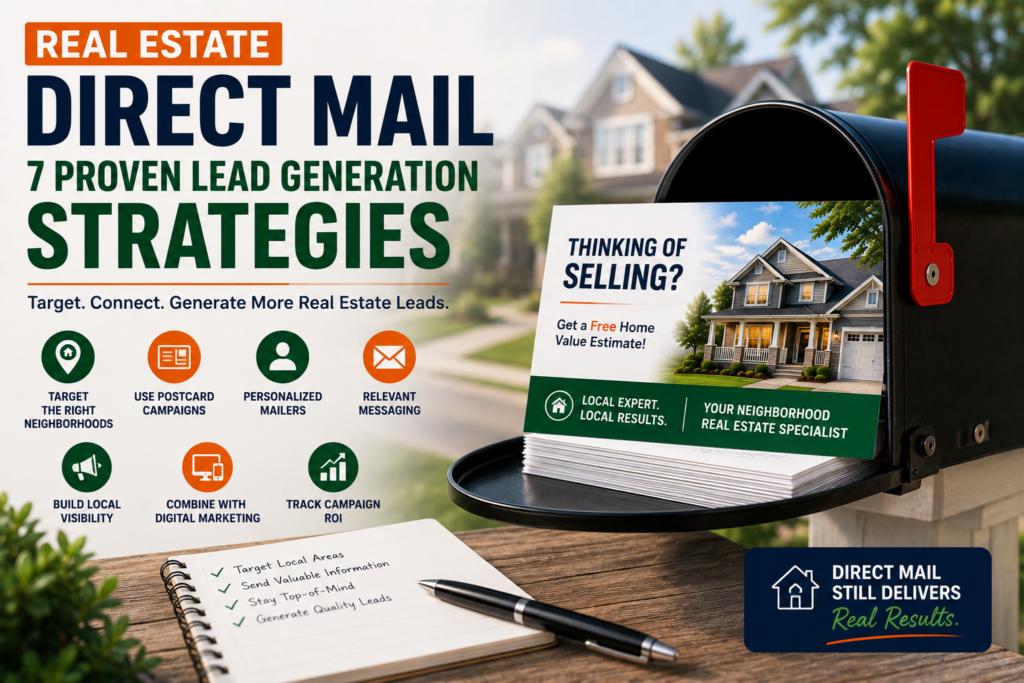
Real estate professionals are constantly looking for effective ways to generate qualified leads, attract new buyers and sellers, and stay visible in competitive local markets. While digital advertising, social media, and email marketing are valuable tools, direct mail continues to provide real estate businesses with a tangible way to connect with potential clients.
Real estate direct mail allows agents, brokers, investors, and property professionals to target specific neighborhoods, homeowners, property owners, and potential buyers with highly relevant marketing messages. Unlike digital ads that can disappear from a screen within seconds, physical mail can remain in a home or office and reinforce your brand over time.
Looking to generate more real estate leads through targeted mailing? Get a Free Quote to discuss your campaign goals, audience, mailing format, and budget with our team.
In this guide, we’ll explore seven proven strategies for using real estate direct mail to generate leads, build local visibility, and create stronger connections with potential buyers and sellers.
What Is Real Estate Direct Mail?
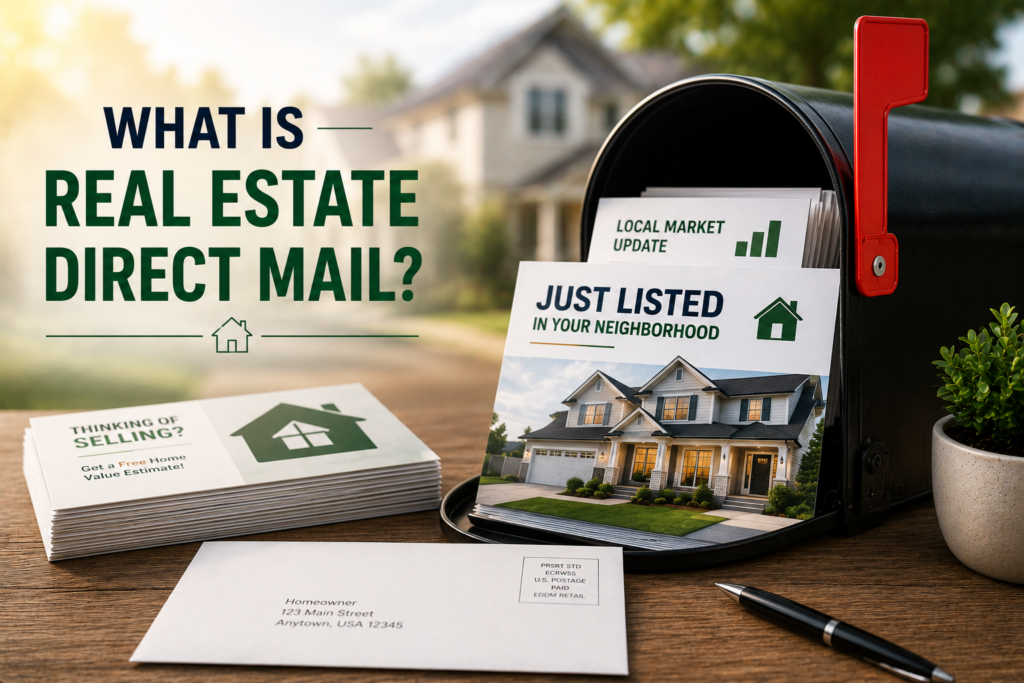
Real estate direct mail is a marketing strategy that uses physical mail to reach potential clients with property-related information, promotional offers, market updates, and real estate services.
Real estate professionals can send materials such as:
- Postcards
- Letters
- Brochures
- Flyers
- Market reports
- Property announcements
- Neighborhood newsletters
- Just-listed and just-sold mailers
The campaign can be targeted by geographic location, ZIP code, neighborhood, property characteristics, homeowner status, or other audience criteria.
This makes direct mail particularly useful for real estate professionals who want to establish a strong presence within specific communities.
Why Direct Mail Works for Real Estate
Real estate is a highly local business. Buyers and sellers often want professionals who understand their neighborhood, property market, and community.
Direct mail can help agents repeatedly put their name and services in front of local homeowners.
Some advantages include:
- Local audience targeting
- Strong brand visibility
- Physical marketing materials
- Personalized messaging
- Repeat exposure
- Neighborhood-specific campaigns
- Integration with digital marketing
- Measurable response tracking
A well-planned campaign can help an agent stay top-of-mind when a homeowner decides to sell or a buyer begins searching for property.
1. Target Specific Neighborhoods
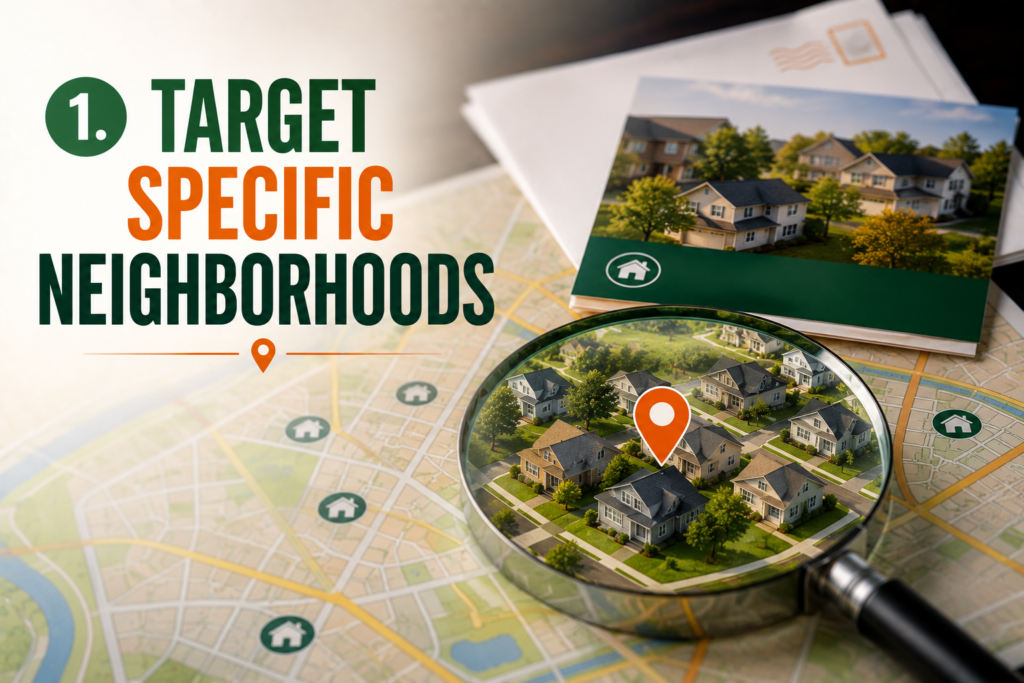
One of the biggest advantages of real estate direct mail is geographic targeting.
Instead of sending marketing materials to an entire city, agents can focus on neighborhoods where they want to build their presence.
For example, an agent specializing in suburban homes could target:
- Specific ZIP codes
- Individual neighborhoods
- New housing developments
- High-value properties
- Recently sold property areas
- Neighborhoods with high homeowner turnover
Targeting a specific geographic area makes your marketing message more relevant and allows you to establish a recognizable presence within the community.
Build a Neighborhood Presence
Sending mail consistently to the same neighborhood can help homeowners become familiar with your name and services.
For example, an agent might send:
Month 1: Local market update
Month 2: Home valuation offer
Month 3: Recently sold property postcard
Month 4: Seller tips
This type of consistent communication can strengthen brand recognition.
2. Use Real Estate Postcards Direct Mail Campaigns
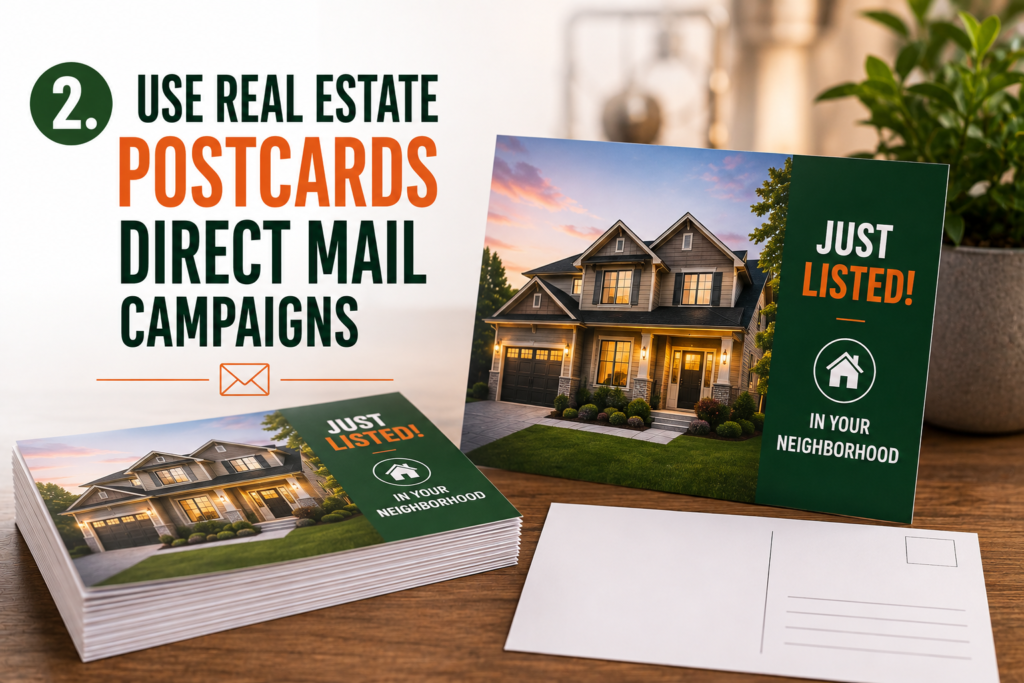
Postcards are one of the most popular formats for real estate marketing because they provide a large visual area for property images, branding, and messaging.
Real estate postcards direct mail campaigns can be used for:
- Just listed properties
- Just sold properties
- Open houses
- New listings
- Home valuation offers
- Market updates
- Buyer opportunities
- Seller services
- Neighborhood reports
A strong postcard should communicate its main message quickly.
For example:
Just Listed in Your Neighborhood
3-Bedroom Home Now Available
Scan the QR Code for Photos and Details
The goal is to capture attention and encourage the recipient to take the next step.
3. Create Personalized Real Estate Mailers
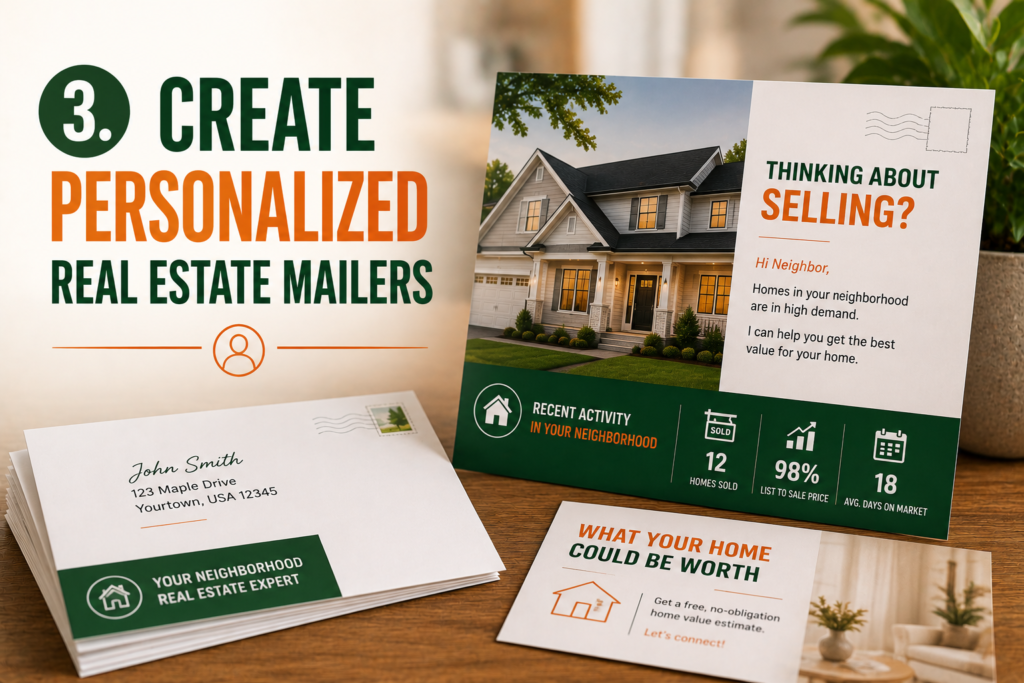
Generic advertising can be easy to ignore. Personalized real estate mailers can make your message more relevant to the recipient.
You can personalize campaigns based on:
- Neighborhood
- Property type
- Homeownership
- Local market conditions
- Previous interactions
- Property value
- Buyer or seller interests
For example, instead of sending a generic message that says:
Thinking About Selling?
An agent could create a neighborhood-specific message:
Thinking About Selling Your Home in [Neighborhood]?
Find Out What Homes Like Yours Are Selling For.
This makes the campaign feel more relevant and local.
Use Different Messages for Buyers and Sellers
Buyers and sellers have different needs.
Potential sellers may respond to:
- Free home valuations
- Local market reports
- Selling guides
- Recent sales
- Home preparation tips
Potential buyers may respond to:
- New listings
- Open houses
- Buyer guides
- Mortgage information
- Neighborhood property opportunities
Segmenting your audience allows you to deliver more relevant messages.
4. Offer Free Home Valuations
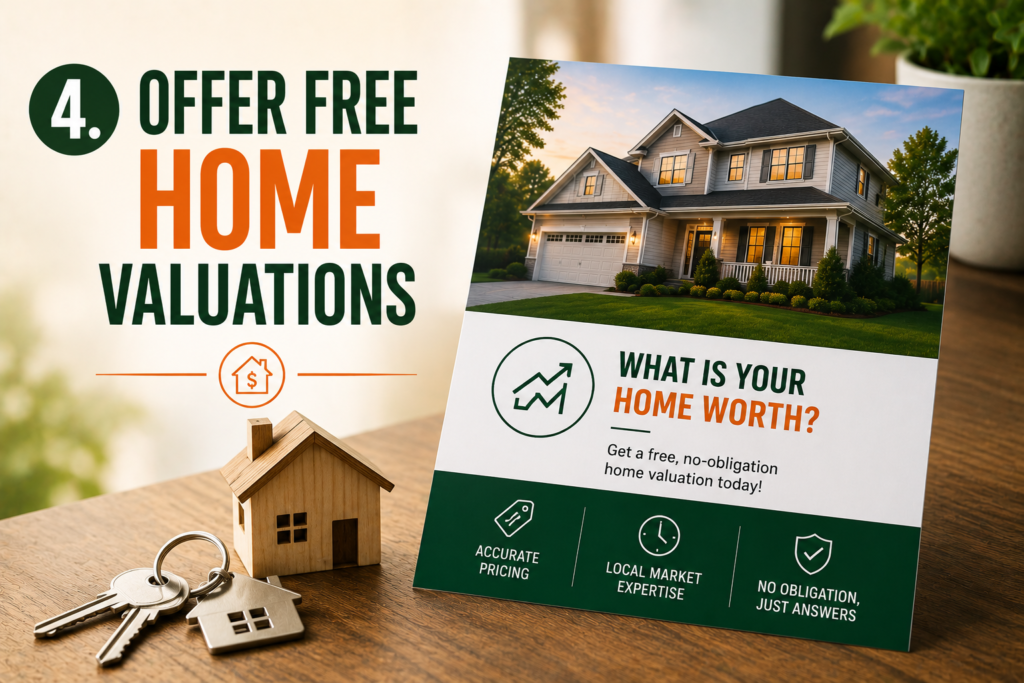
A free home valuation can be an effective call-to-action for seller-focused campaigns.
Homeowners may be curious about how much their property is currently worth even if they aren’t ready to sell immediately.
Your direct mail campaign could promote:
Free Home Value Report
Discover What Your Home Could Sell For in Today’s Market.
You can include a QR code that takes homeowners to an online valuation form.
This creates a bridge between physical marketing and digital lead generation.
Once a homeowner submits their information, the agent can follow up with a personalized conversation.

5. Promote Local Market Expertise
Real estate professionals compete with many other agents. Demonstrating local expertise can help differentiate your business.
Instead of making every campaign purely promotional, provide useful information.
Your mailers could include:
- Recent neighborhood sales
- Average home prices
- Market trends
- Days on market
- Inventory updates
- Buyer demand
- Selling tips
- Home improvement suggestions
For example:
Your Neighborhood Real Estate Update
See how property values have changed over the last 12 months.
This approach positions the agent as a source of useful local information rather than simply another salesperson.
6. Use Strong Calls-to-Action
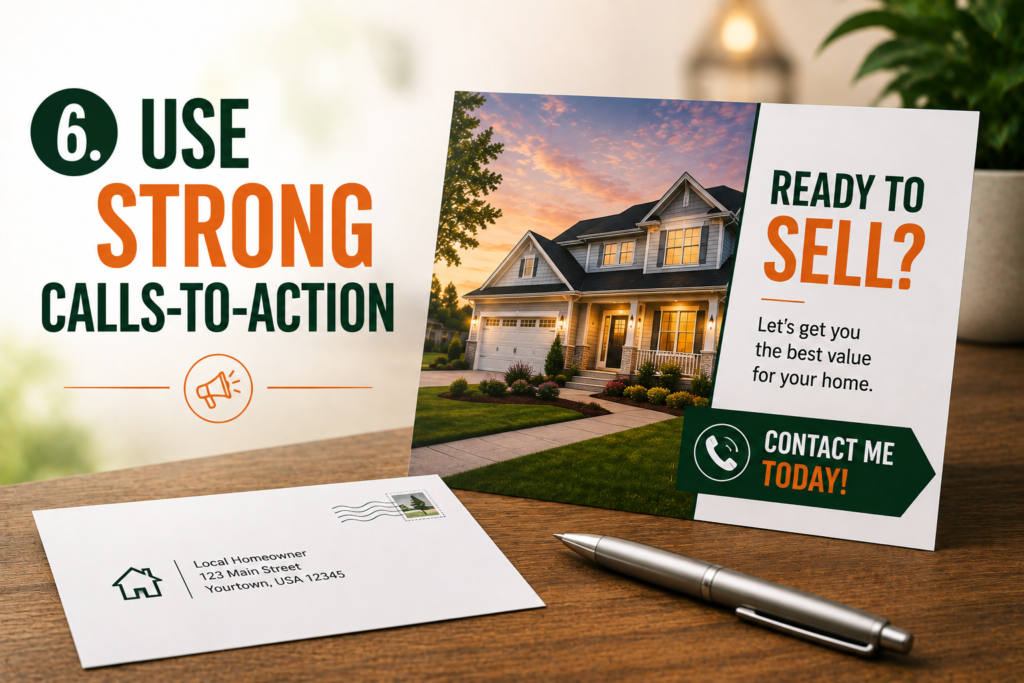
Every direct mail campaign should tell recipients what to do next.
A weak call-to-action may result in lost opportunities, even when the rest of the mailpiece is well designed.
Effective real estate CTAs include:
- Get Your Free Home Valuation
- Schedule a Consultation
- View New Listings
- Scan for Property Photos
- Request a Market Report
- Call for a Free Property Analysis
- Book a Buyer Consultation
- Visit Our Website
Keep the CTA simple and easy to follow.
Adding a QR code can make it easier for recipients to move from your postcard to your website, property listing, or lead form.

7. Track and Improve Your Campaign
One of the most important parts of real estate direct mail is measuring performance.
Tracking allows you to understand which campaigns generate the most interest and leads.
Monitor metrics such as:
- QR code scans
- Website visits
- Phone calls
- Form submissions
- Property inquiries
- Consultation requests
- Home valuation requests
- Appointments
- Leads generated
- Closed transactions
You can also use unique promotional codes, landing pages, phone numbers, or URLs to identify responses from individual campaigns.
For example, you could create a landing page specifically for one neighborhood campaign.
This allows you to determine how many homeowners visited the page and how many eventually became leads.
Types of Real Estate Mailers
Different situations require different marketing materials.
Just Listed Postcards
These postcards promote new properties and can generate interest from potential buyers.
Just Sold Postcards
Just-sold mailers can demonstrate an agent’s activity in a neighborhood and potentially attract homeowners considering selling.
Open House Mailers
These can be used to promote upcoming open houses to nearby residents and potential buyers.
Home Valuation Mailers
These encourage homeowners to discover the potential value of their property.
Market Update Mailers
Market reports provide useful information while establishing the agent as a local expert.
Farming Mailers
Neighborhood farming involves consistently sending marketing materials to a specific geographic area to build long-term recognition.
How Real Estate Mailers Generate Leads
Real estate mailers can generate leads by creating awareness and providing a clear next step.
A typical campaign might work like this:
- A homeowner receives a postcard.
- The postcard highlights a local market trend.
- The homeowner becomes curious about their property value.
- They scan a QR code.
- They complete a home valuation form.
- The agent receives the lead.
- The agent follows up with the homeowner.
This process turns a physical marketing piece into a measurable lead-generation tool.
Combining Real Estate Direct Mail With Digital Marketing
Direct mail becomes even more effective when combined with digital channels.
Consider connecting your campaign with:
- Local SEO
- Google Ads
- Email marketing
- Social media
- Retargeting
- Property listing pages
- Landing pages
- Online appointment scheduling
For example, a postcard can promote a new property and direct recipients to a dedicated listing page.
A homeowner who isn’t ready to contact the agent immediately can still visit the website and learn more about the property.
This creates multiple opportunities for engagement.
How Often Should Real Estate Agents Send Mail?
Consistency is often more important than sending one large campaign.
A single postcard may generate some interest, but repeated exposure can help strengthen brand recognition.
Depending on the campaign budget, an agent could consider:
- Monthly neighborhood mailers
- Quarterly market updates
- Seasonal campaigns
- Just-listed campaigns
- Just-sold campaigns
- Special event promotions
The ideal frequency depends on your target audience, campaign objectives, budget, and market.
The key is to maintain consistent communication without overwhelming recipients.
Common Real Estate Direct Mail Mistakes
Even a well-funded campaign can underperform if the strategy isn’t planned properly.
Avoid these common mistakes:
Using Generic Messaging
Make your message relevant to the neighborhood or audience.
Sending One-Time Mailings
Real estate marketing often benefits from repeated exposure.
Overloading the Design
Too much text can make your mailpiece difficult to understand.
Weak Calls-to-Action
Tell recipients exactly what action they should take.
No Digital Connection
Use QR codes and landing pages to make it easy for recipients to continue their journey online.
Not Tracking Results
Without tracking, you won’t know which campaigns are generating leads.
Ignoring Audience Segmentation
Different homeowners and buyers have different needs. Segment your audience whenever possible.
Real Estate Direct Mail Best Practices
To get the most from your campaigns:
- Target specific neighborhoods.
- Keep messaging simple.
- Use professional photography.
- Highlight one primary offer.
- Include a strong CTA.
- Add QR codes when appropriate.
- Maintain consistent branding.
- Personalize campaigns where possible.
- Combine mail with digital marketing.
- Track responses.
- Test different designs and offers.
- Continue improving based on campaign data.
Frequently Asked Questions
Is real estate direct mail still effective?
Yes. Direct mail can be an effective way for real estate professionals to reach homeowners and potential buyers, particularly when campaigns are geographically targeted and consistently executed.
What are the best real estate mailers?
Postcards, just-listed mailers, just-sold postcards, market reports, home valuation mailers, and neighborhood newsletters are popular options for real estate marketing.
Do real estate postcards direct mail campaigns generate leads?
They can. The effectiveness depends on factors such as targeting, design, offer, messaging, frequency, and call-to-action. Including QR codes, landing pages, or dedicated contact methods can make results easier to track.
How can real estate agents target homeowners?
Agents can target specific neighborhoods, ZIP codes, property characteristics, homeowner demographics, and other relevant audience criteria depending on the campaign.
How can I track real estate direct mail leads?
Use campaign-specific QR codes, landing pages, phone numbers, URLs, or promotional codes. These tools help identify which mailings generate inquiries and leads.
Should real estate agents combine direct mail with digital marketing?
Yes. Combining direct mail with local SEO, social media, email marketing, Google Ads, and landing pages can create a stronger multichannel strategy.
Final Thoughts
Real estate direct mail remains a valuable lead-generation strategy for agents, brokers, investors, and other property professionals who want to build a strong presence in specific communities. By targeting the right neighborhoods, creating engaging real estate mailers, offering useful information, and providing clear calls-to-action, businesses can turn physical mail into meaningful customer opportunities.
Real estate postcards direct mail campaigns can be especially effective when combined with QR codes, landing pages, and digital follow-up. Rather than treating direct mail as a standalone marketing channel, integrate it with your broader digital strategy and track the results.
The key to success is consistency, relevance, and measurement. Reach the right audience, provide something valuable, make the next step easy, and continually improve your campaigns based on performance.
Ready to generate more real estate leads through targeted direct mail? Get a Free Quote and start planning a campaign designed around your market, audience, and business goals.