
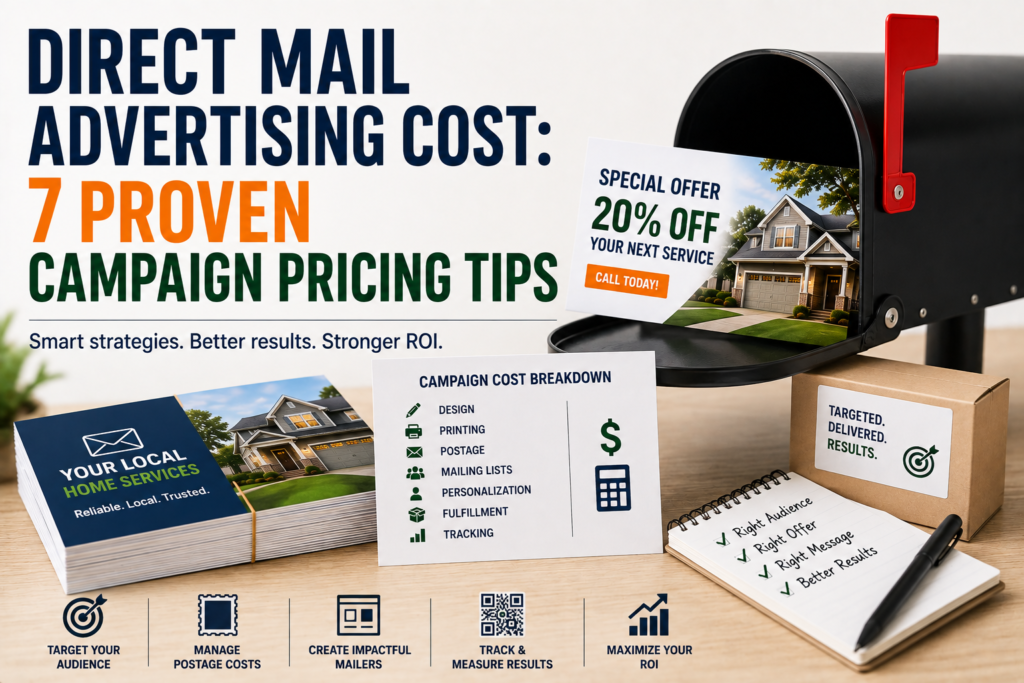
Understanding direct mail advertising cost is one of the first steps businesses should take before launching a direct mail campaign. While direct mail can be an effective way to reach local customers, the total investment depends on several factors, including printing, postage, mailing lists, design, quantity, and campaign management.
There is no single price that applies to every campaign. A simple postcard campaign may have very different costs from a personalized letter, brochure, catalog, or Every Door Direct Mail (EDDM) campaign. Understanding these variables can help businesses create a realistic budget and avoid unnecessary expenses.
Planning a direct mail campaign and want to know what it could cost? Get a Free Quote to discuss your campaign goals, audience, mailing format, and budget with our team.
In this guide, we’ll break down the major factors that influence direct mail pricing, explain how to manage your mail campaign cost, and share seven proven tips for getting more value from your direct mail investment.
What Is Direct Mail Advertising Cost?
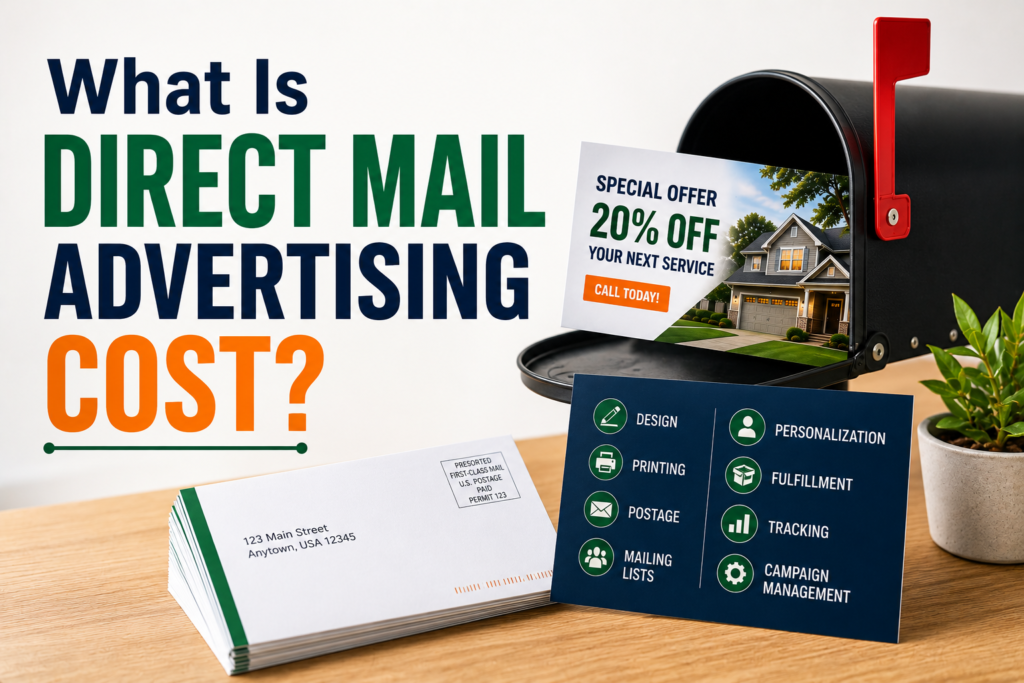
Direct mail advertising cost refers to the total amount a business spends to create, prepare, and distribute physical marketing materials to potential or existing customers.
Depending on the campaign, your costs may include:
- Graphic design
- Copywriting
- Printing
- Postage
- Mailing lists
- Addressing
- Sorting and preparation
- Fulfillment
- Personalization
- Tracking
- Campaign management
Because every campaign is different, it’s better to calculate the total cost based on your specific requirements instead of relying on one general price.
For example, sending 5,000 standard postcards to a targeted local audience will have a different cost structure than sending 1,000 personalized letters to existing customers.
What Factors Affect Direct Mail Pricing?
Several factors can influence the final price of your campaign.
Mail Format
Postcards, letters, brochures, catalogs, and self-mailers have different production requirements.
Quantity
Larger quantities may reduce the cost per piece, depending on printing and mailing specifications.
Postage
Postage depends on the mail type, size, weight, quantity, and mailing method.
Targeting
A specialized mailing list may add to your campaign expenses but can improve audience relevance.
Design
Professional graphic design and copywriting can increase the initial investment while helping your mailpiece make a stronger impression.
Personalization
Variable names, offers, images, or other personalized elements can affect production costs.
Fulfillment
Addressing, inserting, sorting, bundling, and other preparation services may contribute to the overall cost.
Understanding these factors makes it easier to control your mail campaign cost.
1. Choose the Right Mail Format
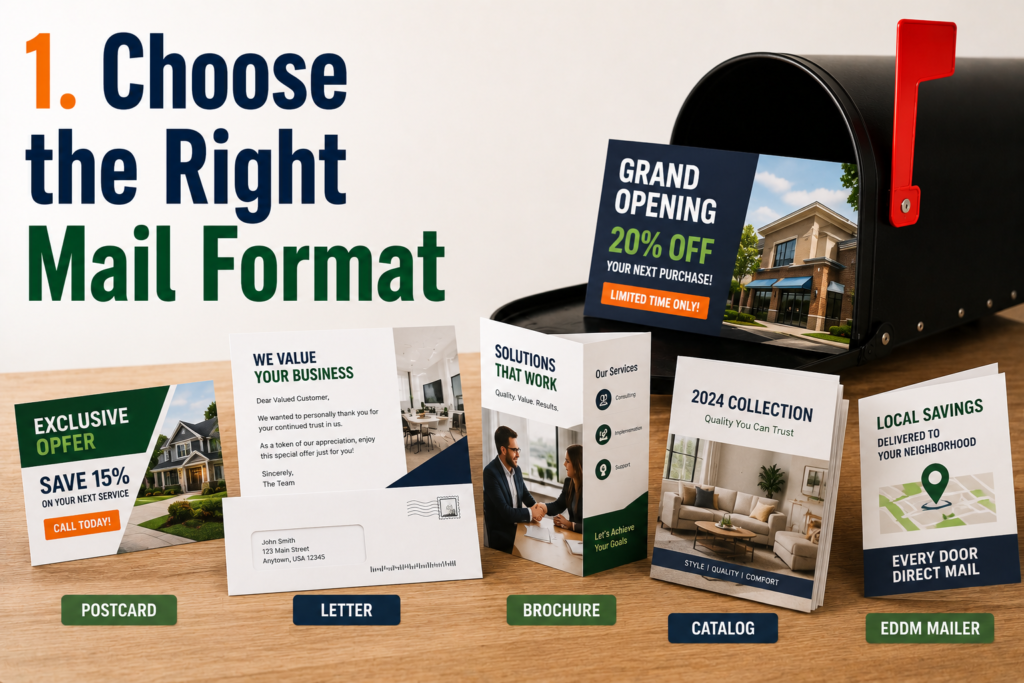
One of the easiest ways to control direct mail advertising cost is to choose a mail format that fits your campaign objective.
Postcards
Postcards are popular because they are straightforward, visually appealing, and don’t require an envelope.
They’re useful for:
- Special offers
- Coupons
- Seasonal promotions
- Grand openings
- Local events
- Service promotions
Letters
Letters provide more space for detailed or personalized messaging.
They’re useful for:
- Professional services
- Customer retention
- Personalized promotions
- Fundraising
- B2B communication
Brochures
Brochures work well when you need to explain several products or services.
Catalogs
Catalogs are useful for retailers and businesses with larger product selections.
EDDM Mailers
Every Door Direct Mail can help businesses reach households along selected postal routes without purchasing an individually addressed mailing list.
The cheapest format isn’t necessarily the best option. Choose a format that allows you to communicate your message effectively while staying within your budget.
2. Plan Your Mailing Quantity Carefully
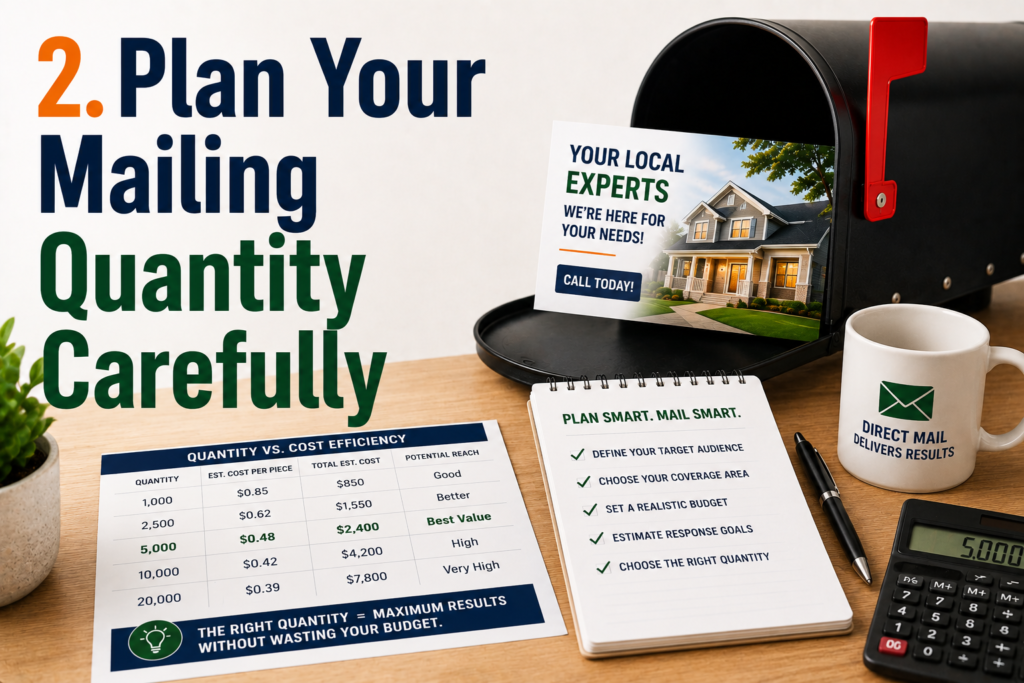
The number of pieces you send has a major effect on your mail campaign cost.
A small campaign may have a higher cost per piece, while larger printing quantities can sometimes provide better unit pricing.
However, ordering more isn’t automatically more cost-effective.
For example, if your business has only 3,000 relevant prospects, sending 10,000 mailpieces may increase your expenses without generating enough additional business to justify the investment.
Before deciding on quantity, consider:
- Your target audience size
- Geographic coverage
- Marketing budget
- Expected response rate
- Customer lifetime value
- Campaign frequency
The goal is to reach enough people to generate meaningful results without paying to reach an audience that isn’t relevant to your business.
3. Understand Postage Costs
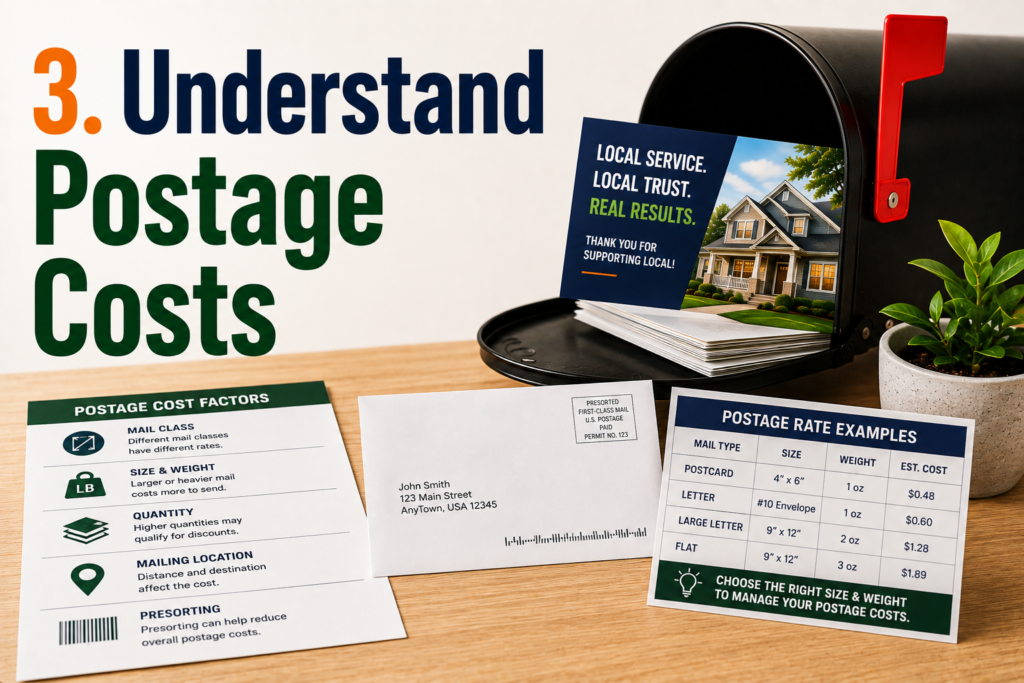
Postage is one of the most important components of direct mail pricing.
Your postage expenses can vary depending on:
- Mail class
- Mailpiece size
- Weight
- Quantity
- Presorting
- Delivery method
- Mailing location
Because postage can represent a significant portion of a campaign budget, businesses should consider it before finalizing their design.
For example, an oversized or unnecessarily heavy mailpiece may cost more to send than a simple postcard.
Consider EDDM for Local Campaigns
Businesses that want to reach entire neighborhoods can consider Every Door Direct Mail.
EDDM allows businesses to select specific postal routes and distribute mail to eligible addresses without purchasing an individually addressed mailing list.
This can be useful for:
- Restaurants
- Roofing companies
- HVAC businesses
- Dental practices
- Real estate agencies
- Landscaping companies
- Gyms
- Local retailers
- Home improvement businesses
If your objective is broad local awareness rather than highly specific household targeting, EDDM may be worth considering.
4. Use a Targeted Mailing List
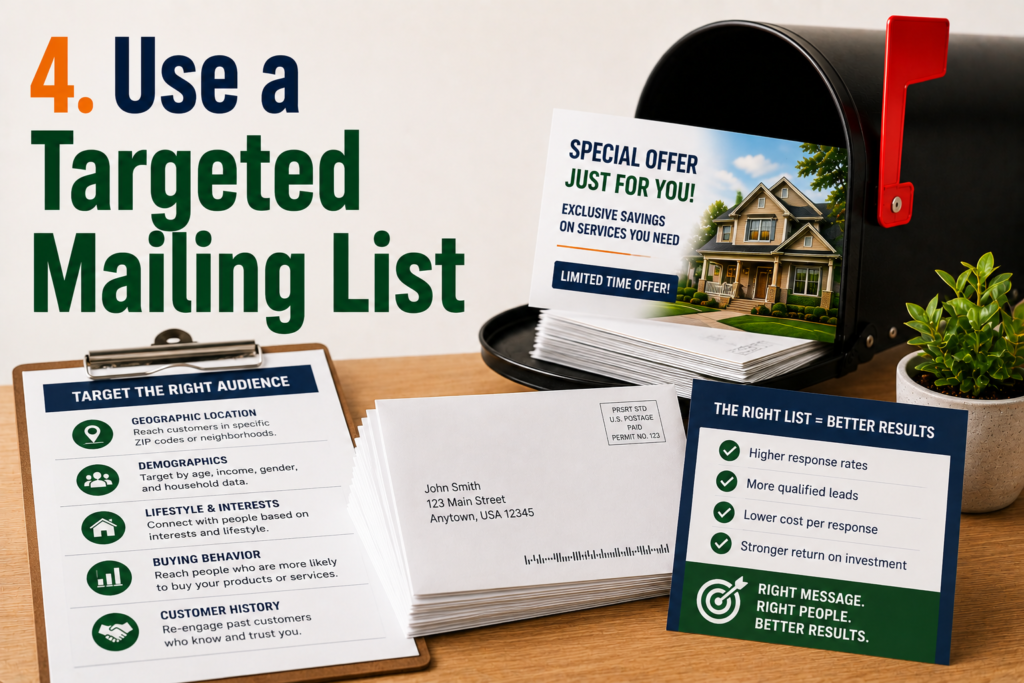
A larger mailing list doesn’t necessarily produce better results.
If your marketing materials are sent to people who aren’t interested in your products or services, you may spend money on printing and postage without generating meaningful responses.
Instead, focus on recipients who match your ideal customer profile.
You can target audiences based on:
- ZIP codes
- Neighborhoods
- Household income
- Homeownership
- Age
- Geographic location
- Customer history
- Business type
- Service area
For example, a roofing company may focus on homeowners in specific neighborhoods rather than sending mail throughout an entire city.
Better targeting can help make your mail campaign cost more efficient by reducing wasted mailings.
5. Invest in Effective Design and Messaging
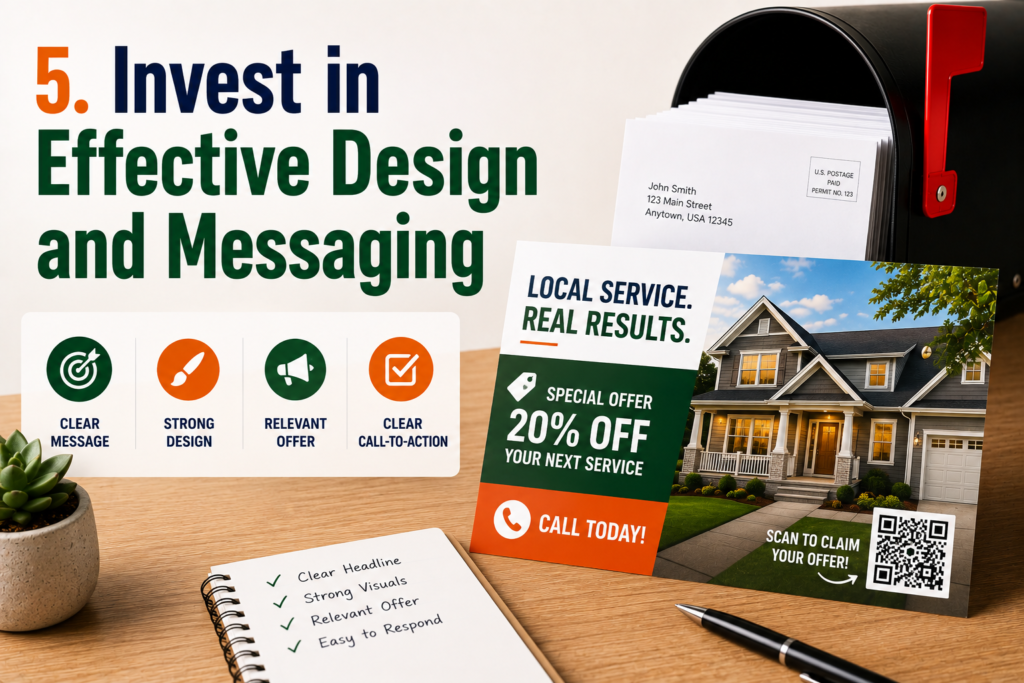
Your direct mail piece has only a short amount of time to capture attention.
A professionally designed mailer should communicate its main message quickly.
Include:
- A compelling headline
- A clear offer
- High-quality images
- Consistent branding
- Easy-to-read text
- Contact information
- A strong call-to-action
Avoid overcrowding the mailpiece with too much information.
Instead, focus on one primary message.
For example:
Get 20% Off Your First Service
Schedule Your Free Consultation
Call Today for a Free Estimate
Scan the QR Code to Claim Your Offer
A clear and relevant message can make your campaign more effective without requiring unnecessary design elements.
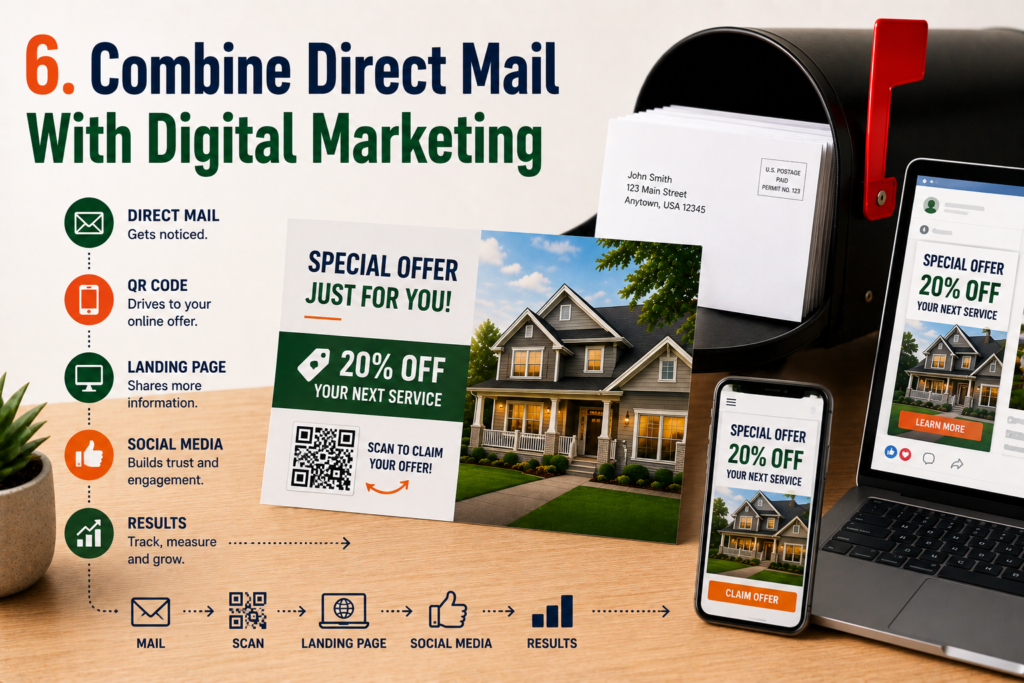
6. Combine Direct Mail With Digital Marketing
Direct mail doesn’t have to operate separately from your online marketing.
Combining physical and digital channels can create multiple opportunities for customers to interact with your business.
Your mailpiece can include a QR code that directs customers to:
- A landing page
- Appointment scheduling
- A special offer
- A product page
- A contact form
- An online coupon
You can also connect your campaign with:
- Email marketing
- Social media
- Google Ads
- Local SEO
- SMS marketing
- Retargeting
For example, a postcard can introduce a limited-time offer, while a QR code sends customers to a landing page where they can redeem it.
This creates a smoother customer journey and provides additional ways to measure campaign performance.
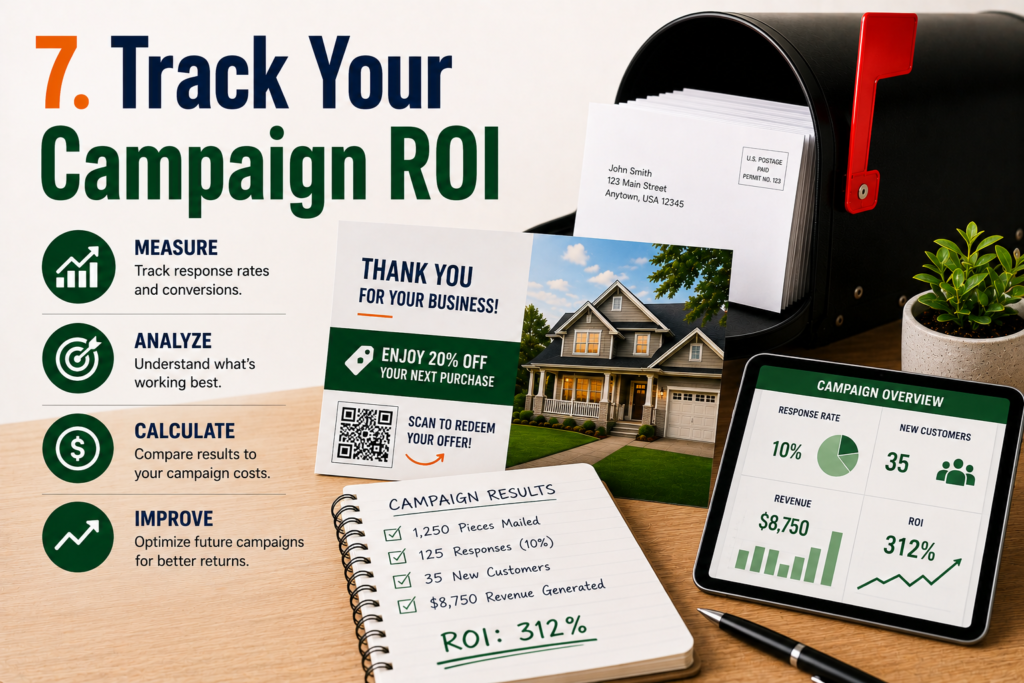
7. Track Your Campaign ROI
The cheapest campaign isn’t necessarily the most successful one.
Instead of focusing only on how much you spend per piece, look at what your campaign generates.
Track metrics such as:
- Response rate
- Leads
- Website visits
- QR code scans
- Phone calls
- Coupon redemptions
- Appointment bookings
- Sales
- Cost per lead
- Customer acquisition cost
- Return on investment
For example, suppose you spend $2,000 on a direct mail campaign and generate 40 qualified leads.
Your cost per lead would be:
$2,000 ÷ 40 = $50 per lead
If several of those leads become long-term customers, the campaign may generate significantly more value than the initial $2,000 investment.
This is why businesses should evaluate direct mail pricing based on results, not just the initial price.
Direct Mail Campaign Cost Breakdown
When planning your budget, consider every part of the campaign.
| Cost Factor | What It Covers |
| Design | Graphic design and layout |
| Copywriting | Headlines, offers, and marketing copy |
| Printing | Production of mailpieces |
| Mailing List | Audience data and targeting |
| Postage | Delivery costs |
| Personalization | Variable names, offers, or content |
| Preparation | Sorting, addressing, and bundling |
| Fulfillment | Assembly and distribution |
| Tracking | QR codes, URLs, promo codes, etc. |
Not every campaign will require every service.
For example, a small business with existing artwork and customer data may have fewer expenses than a company starting from scratch.
Example of a Direct Mail Campaign Budget
Imagine a local business wants to send 5,000 postcards.
The campaign could involve:
- Postcard design
- Printing
- Mailing list or audience targeting
- Postage
- Mailing preparation
- QR code tracking
- Landing page development
The exact direct mail advertising cost will depend on the specifications of the campaign.
Rather than relying on a fixed industry price, businesses should request a customized quote based on:
- Number of mailpieces
- Mail format
- Size
- Paper type
- Target audience
- Geographic area
- Postage requirements
- Design requirements
- Additional services
This provides a more accurate estimate of the actual campaign investment.
How to Reduce Direct Mail Advertising Cost
Reducing costs doesn’t mean choosing the lowest-quality materials or sending fewer mailpieces.
Instead, focus on improving efficiency.
Improve Audience Targeting
Reach people who are more likely to need your products or services.
Choose an Appropriate Format
Don’t use an expensive brochure when a postcard can communicate the offer effectively.
Compare Mailing Quantities
Ask for pricing at different quantities to determine how volume affects your cost per piece.
Simplify Your Design
Avoid unnecessary finishing or complicated formats that don’t contribute to your marketing objective.
Consider EDDM
For broad neighborhood campaigns, EDDM may be an efficient option.
Test Before Scaling
Start with a manageable audience, track results, and expand campaigns that perform well.
Combine Services
Working with an experienced direct mail provider for design, printing, mailing, and fulfillment can simplify campaign management.
Direct Mail Pricing vs. Digital Advertising Costs
Businesses often compare direct mail with digital advertising, but the cost structures are very different.
Digital campaigns may involve:
- Ad spend
- Cost per click
- Cost per impression
- Landing page development
- Creative production
- Management fees
Direct mail may involve:
- Printing
- Postage
- Mailing lists
- Design
- Preparation
- Fulfillment
Instead of asking which channel is cheaper, businesses should compare the results generated by each marketing channel.
For some businesses, digital marketing may produce immediate online traffic, while direct mail can help create physical brand awareness and reach local households.
Using both channels together can create a stronger overall marketing strategy.
Common Mistakes That Increase Mail Campaign Cost
Several mistakes can cause businesses to spend more without improving campaign performance.
Sending Mail to the Wrong Audience
Poor targeting can waste printing and postage expenses.
Ordering Too Many Pieces
Volume discounts aren’t useful if thousands of mailpieces aren’t needed.
Using an Unnecessary Premium Format
A simple postcard may accomplish your goal without the added expense of a complex mailer.
Ignoring Postage During Design
Mailpiece dimensions and weight can affect postage, so consider delivery costs before finalizing your design.
Using a Weak Offer
A beautiful mailer won’t perform well if customers don’t have a compelling reason to respond.
Failing to Track Results
Without tracking, it’s difficult to know whether your mail campaign cost produced a worthwhile return.
Is Direct Mail Worth the Investment?
For many businesses, direct mail can be an effective way to reach potential customers when the campaign is properly planned and targeted.
It can help businesses:
- Generate qualified leads
- Promote special offers
- Increase local awareness
- Drive website traffic
- Encourage appointments
- Reconnect with previous customers
- Promote new locations
- Increase sales
The key is to treat direct mail as a measurable marketing investment rather than simply an expense.
A carefully targeted campaign with a strong offer and clear tracking can provide much more value than a large, untargeted mailing.
Frequently Asked Questions
How much does direct mail advertising cost?
The cost depends on factors such as the mail format, quantity, printing, postage, mailing list, design, preparation, and fulfillment. The best way to determine the cost of a specific campaign is to request a customized quote based on your requirements.
What affects direct mail pricing the most?
The main factors include printing, postage, mailing quantity, mail format, audience targeting, design, personalization, and preparation.
What is the cheapest type of direct mail?
Postcards can be a cost-effective option for many businesses. EDDM can also be useful for businesses that want broad neighborhood coverage without purchasing an individually addressed mailing list.
How can I reduce my mail campaign cost?
You can reduce unnecessary expenses by targeting the right audience, choosing an appropriate format, comparing quantities, optimizing your mailpiece, considering EDDM when appropriate, and tracking campaign results.
Is direct mail more expensive than email marketing?
Direct mail typically has physical production and postage expenses, while email marketing generally has lower distribution costs. However, businesses should compare the actual leads, conversions, revenue, and customer value generated by each channel rather than comparing costs alone.
How can I measure direct mail ROI?
Use tracking tools such as unique promotional codes, QR codes, dedicated landing pages, unique URLs, and campaign-specific phone numbers. These tools can help identify responses generated by your mailing campaign.
Final Thoughts
Understanding direct mail advertising cost helps businesses create realistic marketing budgets and make better campaign decisions. Instead of focusing on a single price per mailpiece, consider the complete campaign investment, including design, printing, postage, targeting, preparation, and tracking.
The most effective strategy is to choose the right format, reach a relevant audience, create a compelling offer, and measure the results. By following these seven pricing tips, businesses can manage their direct mail pricing more effectively while creating campaigns designed to generate meaningful business results.
Whether you’re planning a small postcard campaign or a larger local mailing, professional direct mail marketing services can help simplify the process from planning and design to printing and delivery.
Ready to find out what your campaign could cost? Get a Free Quote and let We Do For You help you plan a direct mail campaign around your goals and budget.