
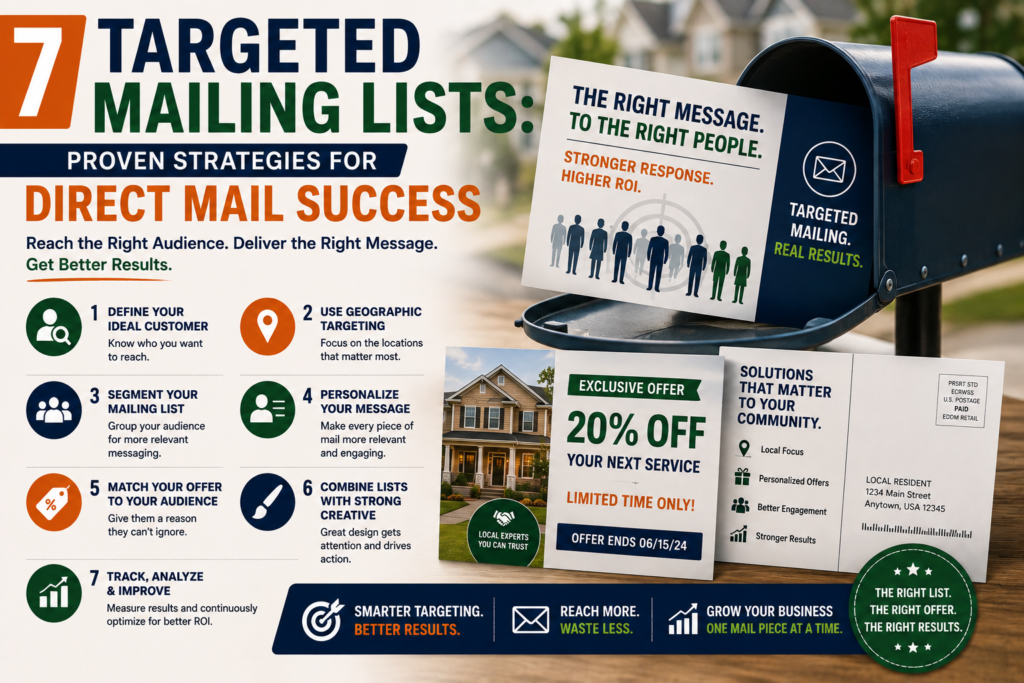
A successful direct mail campaign starts with one important decision: who should receive your marketing message? Even the most creative postcard, brochure, or promotional offer can underperform if it reaches the wrong audience. This is where targeted mailing lists become an important part of a successful direct mail strategy.
Instead of sending marketing materials to a broad audience, businesses can use targeted lists to reach people based on location, demographics, customer behavior, purchasing history, and other relevant characteristics. Reaching the right audience makes your message more relevant and can help improve response rates, lead quality, and marketing ROI.
Whether you’re a local business trying to reach nearby customers or an established company expanding into new markets, using the right mailing list can make your direct mail campaign more efficient and effective.
In this guide, we’ll explore seven proven strategies for using targeted mailing lists to create stronger direct mail campaigns.
What Are Targeted Mailing Lists?
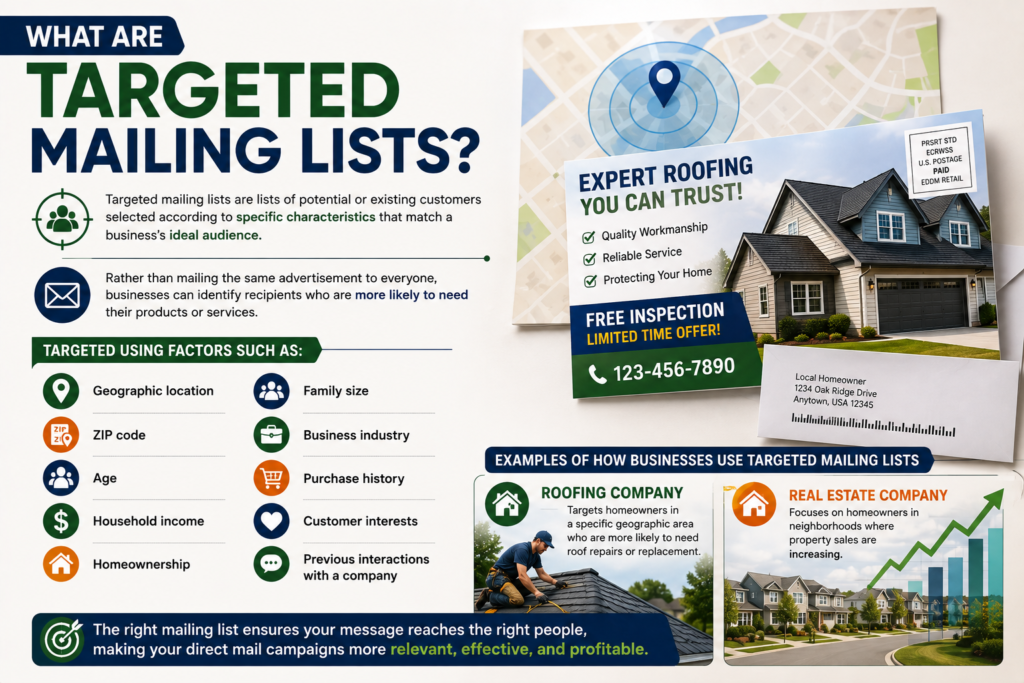
Targeted mailing lists are lists of potential or existing customers selected according to specific characteristics that match a business’s ideal audience.
Rather than mailing the same advertisement to everyone, businesses can identify recipients who are more likely to need their products or services.
Depending on the campaign, a mailing list may be targeted using factors such as:
- Geographic location
- ZIP code
- Age
- Household income
- Homeownership
- Family size
- Business industry
- Purchase history
- Customer interests
- Previous interactions with a company
For example, a roofing company may target homeowners in a specific geographic area, while a real estate company may focus on homeowners in neighborhoods where property sales are increasing.
Why Targeted Mailing Lists Matter
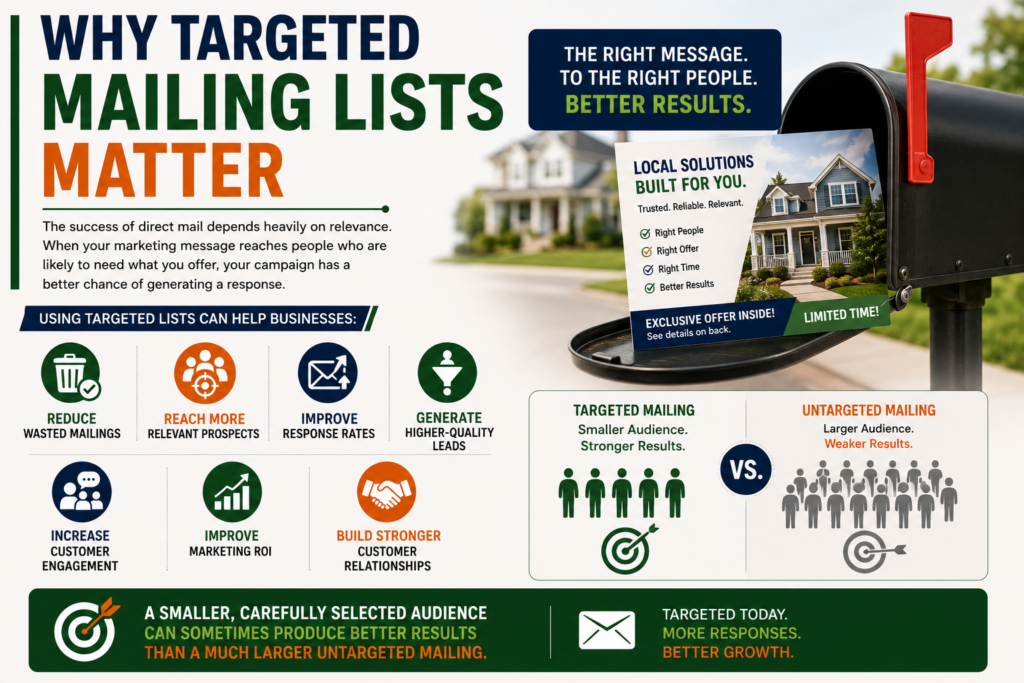
The success of direct mail depends heavily on relevance. When your marketing message reaches people who are likely to need what you offer, your campaign has a better chance of generating a response.
Using targeted lists can help businesses:
- Reduce wasted mailings
- Reach more relevant prospects
- Improve response rates
- Generate higher-quality leads
- Increase customer engagement
- Improve marketing ROI
- Build stronger customer relationships
A smaller, carefully selected audience can sometimes produce better results than a much larger untargeted mailing.
1. Define Your Ideal Customer
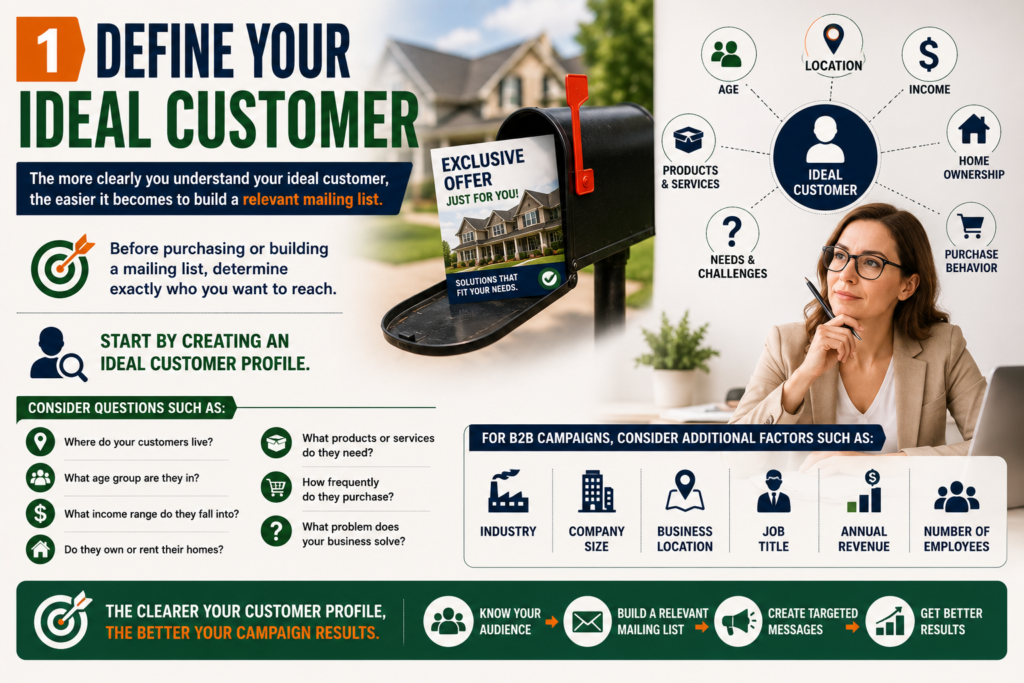
Before purchasing or building a mailing list, determine exactly who you want to reach.
Start by creating an ideal customer profile.
Consider questions such as:
- Where do your customers live?
- What age group are they in?
- What income range do they fall into?
- Do they own or rent their homes?
- What products or services do they need?
- How frequently do they purchase?
- What problem does your business solve?
For B2B campaigns, consider additional factors such as:
- Industry
- Company size
- Business location
- Job title
- Annual revenue
- Number of employees
The more clearly you understand your ideal customer, the easier it becomes to build a relevant mailing list.
2. Use Geographic Targeting
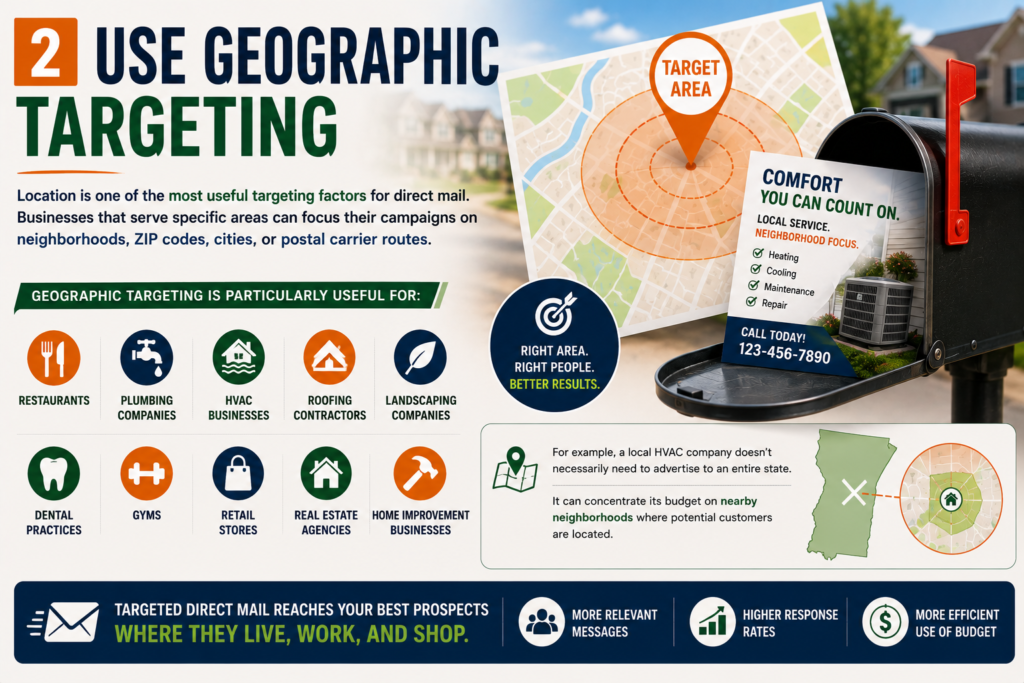
Location is one of the most useful targeting factors for direct mail.
Businesses that serve specific areas can focus their campaigns on neighborhoods, ZIP codes, cities, or postal carrier routes.
Geographic targeting is particularly useful for:
- Restaurants
- Plumbing companies
- HVAC businesses
- Roofing contractors
- Landscaping companies
- Dental practices
- Gyms
- Retail stores
- Real estate agencies
- Home improvement businesses
For example, a local HVAC company doesn’t necessarily need to advertise to an entire state. It can concentrate its budget on nearby neighborhoods where potential customers are located.
This makes targeted direct mail more efficient and relevant.
3. Segment Your Mailing List
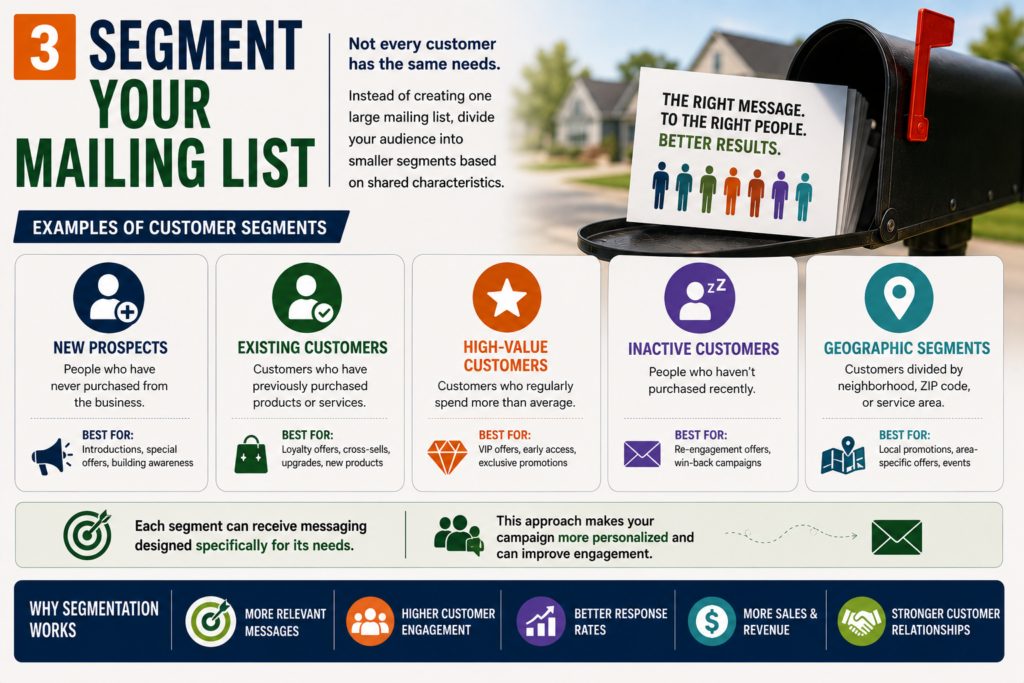
Not every customer has the same needs.
Instead of creating one large mailing list, divide your audience into smaller segments based on shared characteristics.
For example, a business could create separate segments for:
New Prospects
People who have never purchased from the business.
Existing Customers
Customers who have previously purchased products or services.
High-Value Customers
Customers who regularly spend more than average.
Inactive Customers
People who haven’t purchased recently.
Geographic Segments
Customers divided by neighborhood, ZIP code, or service area.
Each segment can receive messaging designed specifically for its needs.
This approach makes your campaign more personalized and can improve engagement.
4. Personalize Your Direct Mail
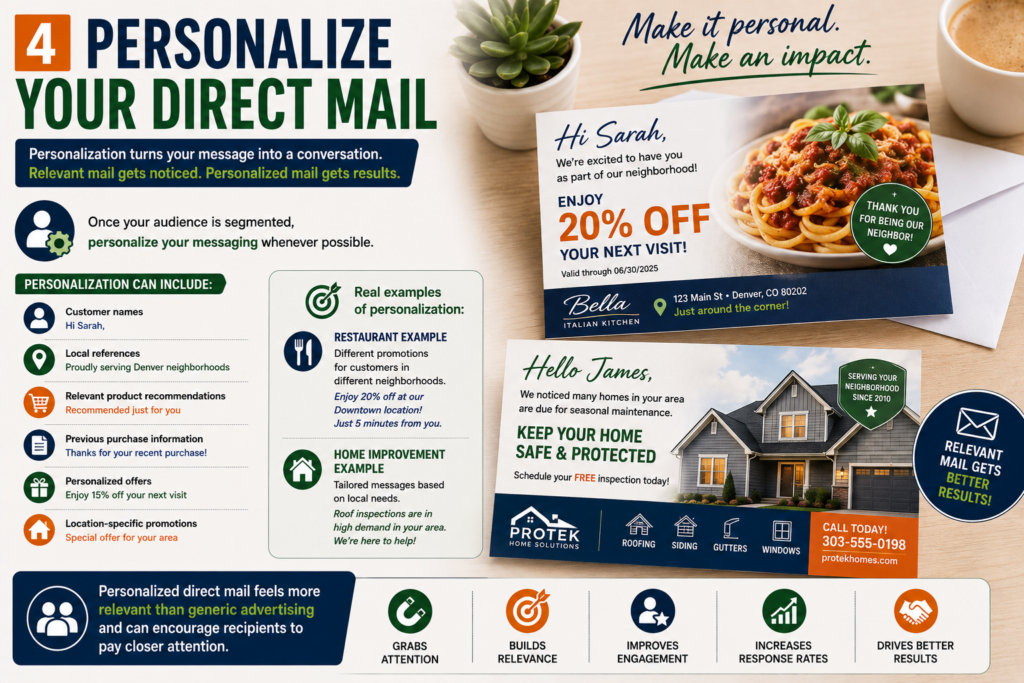
Once your audience is segmented, personalize your messaging whenever possible.
Personalization can include:
- Customer names
- Local references
- Relevant product recommendations
- Previous purchase information
- Personalized offers
- Location-specific promotions
For example, a restaurant could send different promotions to customers living in different neighborhoods. A home improvement company could tailor its message based on the type of service commonly requested in a particular area.
Personalized direct mail feels more relevant than generic advertising and can encourage recipients to pay closer attention.
5. Match Your Offer to Your Audience
A targeted mailing list is only valuable when the offer matches the people receiving it.
Consider what each audience segment is most likely to respond to.
For example:
New customers:
Offer a first-time customer discount or free consultation.
Existing customers:
Promote complementary products or services.
Inactive customers:
Provide a special incentive to return.
Local prospects:
Offer a neighborhood-specific promotion.
Your offer should answer one important question:
Why should this customer take action now?
A relevant offer combined with the right audience can significantly strengthen a direct mail campaign.
6. Combine Mailing Lists with Strong Creative
Even the best direct mail lists cannot compensate for weak marketing materials.
Your postcard, brochure, letter, or flyer should communicate your message quickly and clearly.
A strong direct mail piece should include:
- Attention-grabbing headline
- Clear value proposition
- High-quality visuals
- Concise messaging
- Consistent branding
- Strong call-to-action
- Contact information
- Website or landing page
- QR code when appropriate
Avoid filling the entire mail piece with text. Recipients should be able to understand the main offer within a few seconds.
7. Track and Improve Your Campaign
Creating a mailing list isn’t the final step. You also need to understand how recipients respond.
Track metrics such as:
- Response rate
- Website visits
- QR code scans
- Phone calls
- Coupon redemptions
- Form submissions
- Appointment bookings
- Sales
- Cost per lead
- Return on investment
For example, you can use a unique promotional code specifically for a direct mail campaign. When customers use that code, you can determine how many conversions came from the mailing.
The data you collect can then help improve future campaigns.
Types of Mailing Lists Businesses Can Use
Businesses generally work with several types of mailing lists depending on their marketing goals.
Customer Mailing Lists
These contain information about existing customers and are useful for retention, cross-selling, and repeat purchases.
Prospect Mailing Lists
These lists contain potential customers who match your ideal customer profile but haven’t purchased from your business.
Geographic Mailing Lists
These focus on people or households within specific geographic areas.
Business Mailing Lists
These are useful for B2B campaigns and can be segmented by industry, company size, location, or other business characteristics.
Specialty Mailing Lists
These may focus on specific demographics, interests, property characteristics, or other audience attributes.
The right list depends on your campaign objectives and target audience.
Targeted Mailing Lists vs. General Mailing Lists
The biggest difference is relevance.
A general mailing list may contain a large number of recipients, but not everyone will be interested in your product or service.
A targeted list focuses on recipients who are more likely to become customers.
| Targeted Mailing Lists | General Mailing Lists |
| Focus on specific audiences | Broad audience |
| Higher relevance | Lower relevance |
| Better audience segmentation | Limited segmentation |
| Less potential waste | More potential waste |
| Personalized messaging | Generic messaging |
| Better campaign efficiency | Lower targeting precision |
For businesses with limited marketing budgets, targeted campaigns can help make every mailing dollar work harder.
How to Build a Successful Direct Mail Campaign with Targeted Lists
A strong campaign typically follows these steps:
Step 1: Set Your Goal
Decide whether you’re trying to generate leads, increase sales, promote an event, or build awareness.
Step 2: Define Your Audience
Determine who is most likely to respond to your offer.
Step 3: Build or Obtain Your Mailing List
Choose a reliable list that matches your audience criteria.
Step 4: Segment Your Audience
Divide recipients into groups based on relevant characteristics.
Step 5: Create Your Mail Piece
Design a postcard, letter, brochure, or other format around the needs of the audience.
Step 6: Add a Strong Offer
Give recipients a compelling reason to respond.
Step 7: Include a Clear CTA
Tell recipients exactly what to do next.
Step 8: Launch the Campaign
Print and distribute your marketing materials.
Step 9: Track Results
Measure responses, leads, sales, and other campaign metrics.
Step 10: Optimize
Use your results to improve targeting, messaging, and offers in future campaigns.
Common Mailing List Mistakes to Avoid
Even experienced marketers can make mistakes when managing mailing lists.
Avoid:
Using Outdated Information
Old addresses and inaccurate customer information can lead to wasted mailings.
Targeting Too Broadly
Sending mail to people who are unlikely to need your services can reduce campaign efficiency.
Ignoring Segmentation
Treating every customer exactly the same can result in less relevant messaging.
Failing to Clean Your List
Regularly review your data to remove duplicates, outdated information, and other unnecessary records.
Focusing Only on Quantity
A larger list isn’t always better. Quality and relevance are often more important than size.
How Direct Mail and Digital Marketing Work Together
Direct mail doesn’t need to operate independently.
Businesses can combine targeted mailing lists with digital marketing to create a multichannel customer journey.
For example:
- Send a targeted postcard to potential customers.
- Include a QR code leading to a dedicated landing page.
- Encourage visitors to submit their email address.
- Follow up with an email campaign.
- Retarget interested visitors through digital advertising.
- Track conversions across the campaign.
This approach allows businesses to use the strengths of both physical and digital marketing.
Frequently Asked Questions
What are targeted mailing lists?
Targeted mailing lists contain recipients selected according to specific characteristics such as location, demographics, purchasing behavior, or business type. They help businesses send marketing materials to more relevant audiences.
Why are mailing lists important for direct mail marketing?
The right mailing list helps businesses reach potential customers who are more likely to need their products or services. This can reduce wasted spending and improve campaign performance.
How do I choose the right mailing list?
Start by defining your ideal customer. Then consider factors such as location, demographics, customer behavior, income, homeownership, or business characteristics that align with your campaign goals.
Can small businesses use targeted mailing lists?
Yes. Targeted mailing lists can be particularly valuable for small businesses because they allow companies to focus limited marketing budgets on specific audiences and geographic areas.
How often should I update a mailing list?
Your list should be reviewed regularly to remove outdated information, duplicate records, and addresses that are no longer relevant. The ideal frequency depends on how often your customer data changes.
Final Thoughts
Targeted mailing lists can make the difference between a broad direct mail campaign and a highly focused marketing strategy. By defining your ideal customer, using geographic and demographic targeting, segmenting your audience, personalizing your message, and tracking campaign results, businesses can improve the effectiveness of their direct mail efforts.
The goal isn’t simply to send more mail. It’s to send the right message to the right people at the right time. When targeted lists are combined with compelling offers, professional design, and digital marketing, direct mail can become a powerful channel for generating leads, increasing customer engagement, and supporting long-term business growth.